
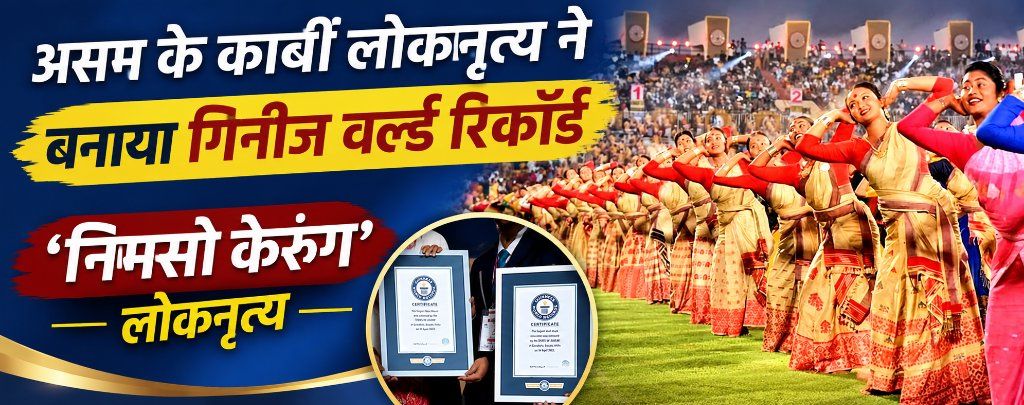

Why in News? (Historic Guinness World Record by Nimso Kerung)
Global Milestone for Indigenous Karbi Tribal Heritage
- Historic Achievement: On 16 November 2026, a colossal ensemble of approximately 15,000 artists assembled at Diphu, the headquarters of Karbi Anglong district in Assam, performing the traditional Karbi indigenous folk dance 'Nimso Kerung' to establish an official Guinness World Record.
- Official Record Title: Conferred the official Guinness certification for the 'Largest Karbi Folk Dance'.
- Lead Organizing Authority: Conceptualized and organized by the Karbi Anglong Autonomous Council (KAAC), a constitutional tribal administrative body established under the Sixth Schedule of the Constitution of India.
- Curriculum Alignment: Directly mapped to MPPSC Prelims Paper 1 Unit 1 & Unit 10 (Indian Heritage, Folk Dances & Tribal Culture) and MPPSC Mains Paper 1 Part A.
Key Data Points: Largest Karbi Folk Dance World Record
| Parameter | Details |
|---|---|
| Date of Event | 16 November 2026 |
| Venue | Diphu, Karbi Anglong District, Assam |
| Folk Dance Form | Nimso Kerung |
| Total Participants | Approximately 15,000 dancers (Men & Women) |
| Official Record Title | Largest Karbi Folk Dance |
| Organizing Body | Karbi Anglong Autonomous Council (KAAC) |
| Guinness Entry Threshold | Minimum 250 performers (Outperformed by 60x) |
| Minimum Performance Duration | At least 5 minutes of unbroken synchronized choreography |
| Dress Code Mandate | 100% authentic woven Karbi tribal ethnic attire |
Nimso Kerung Folk Dance: Etymology, Choreography & Style
1. Etymological Origins
- 'Nimso': In the Tibeto-Burman Karbi language, 'Nimso' signifies a young maiden or unmarried damsel.
- 'Kerung': Translates as 'to choose, invite, or escort together'. Historically, the dance symbolizes social courtship, mutual community trust, and matrimonial alliance selection among tribal youth.
2. Choreography & Musical Instrumentation
- Choreographic Formation: Dancers form interlocking concentric circles and straight arrays, holding waistbands or clasping hands while executing synchronized, rhythmic forward-backward foot steps.
- Acoustic Instruments: Driven by the resonant beats of the 'Cheng' (the indigenous Karbi hand drum), complemented by the bamboo flute 'Murli' / 'Pongsi' and resonant antiphonal chanting.
3. Traditional Indigenous Regalia
- Female Regalia: Handwoven wraparound skirt 'Pini', upper torso drape 'Pekok', and the silver/beaded decorative belt 'Vamkok'.
- Male Regalia: Sleeveless ethnic vest 'Choi', waistcloth 'Rikong', and elegant ceremonial headgear turban 'Poho'.
Assam Comprehensive General Knowledge: Essential Exam Tables
1. Administrative Facts & State Symbols of Assam
| Parameter | Details |
|---|---|
| Date of Formation | 26 January 1950 |
| Capital | Dispur |
| Largest City / Gateway | Guwahati (Gateway to Northeast India) |
| Lifeline Rivers | Brahmaputra and Barak |
| State Animal | One-horned Rhinoceros (Rhinoceros unicornis) |
| State Bird | White-winged Wood Duck (Asarcornis scutulata - Deohah) |
| State Tree | Hollong (Dipterocarpus macrocarpus) |
| State Flower | Foxtail Orchid / Kopou Phool (Rhynchostylis retusa) |
| State Classical Dance | Sattriya (Instituted by Srimanta Sankardev) |
| Major Tribes | Bodo, Karbi, Mishing, Rabha, Dimasa, Tiwa, Deori |
2. 7 National Parks of Assam (Complete Breakdown)
| No. | National Park | Key Biodiversity Highlights |
|---|---|---|
| 1. | Kaziranga National Park | UNESCO World Heritage Site; harbors 2/3rd of world's one-horned rhinos; Tiger Reserve |
| 2. | Manas National Park | UNESCO World Heritage Site; Biosphere Reserve; Pygmy Hog, Golden Langur, Wild Water Buffalo |
| 3. | Nameri National Park | Prime habitat of White-winged Wood Duck & Asian Elephants; Jia Bhoroli river |
| 4. | Orang National Park | Known as 'Mini Kaziranga'; Tiger Reserve located on north bank of Brahmaputra |
| 5. | Dibru-Saikhowa National Park | Biosphere Reserve; feral wild horses and rare white-winged ducks |
| 6. | Dihing Patkai National Park | Termed 'Amazon of the East'; pristine lowland evergreen rainforest & elephant corridor |
| 7. | Raimona National Park | Located in Bodoland Territorial Region (BTR); prime sanctuary for endemic Golden Langur |
3. Art, Culture, Festivals & GI Products
- Prominent Folk Dances: Bihu Dance (celebratory agricultural dance), Bagurumba (butterfly dance of Bodos), Bhortal Dance (neo-Vaishnavite monastery tradition), Jhumur (Tea garden community dance), and Nimso Kerung (Karbi tribe).
- Tri-Bihu Festival Cycle: Rongali (Bohag Bihu - Assamese New Year sowing in April), Kongali (Kati Bihu - pest protection in October), and Bhogali (Magh Bihu - post-harvest feast in January).
- Geographical Indications (GI Tags): Muga Silk (Golden silk of Assam), Assamese Gamosa, Judima Rice Wine (Dimasa tribe - first fermented beverage GI in NE), Kaji Nemu, and Chokuwa (magic rice). Compare with national benchmarks like GI Man of India Dr. Rajnikant, Madhya Pradesh's Burhanpur Banana GI Tag, and Meghalaya Lakadong Turmeric Mission.
- Biodiversity Conservation Frameworks: Kaziranga & Manas are premier UNESCO World Heritage sanctuaries. For global environmental goals and ecological governance, explore the Global Forest Goals 2026 Report.
4. Geography & Heritage Milestones
- Majuli Island: World's largest riverine island on Brahmaputra river and India's first island district. Global hub of Neo-Vaishnavite Sattra monasteries.
- Brahmaputra Flood Risk Management: Regional disaster mitigation and early warning frameworks in the Brahmaputra basin operate under the modernized statutory protocols of the Disaster Management (Amendment) Act 2025.
- Digboi Oil Refinery: Established in 1901; Asia's first and one of the oldest operating crude oil refineries globally.
- Bhupen Hazarika Setu (Dhola-Sadiya Bridge): 9.15 km bridge over Lohit river connecting Assam with Arunachal Pradesh, one of India's longest water bridges.
- International Frontiers: Shares international land borders with Bhutan to the north and Bangladesh to the south and west.
- Culture & Exam Synthesis: For broader art, culture and cinema honors, refer to the 72nd National Film Awards 2026 Winners List and Aakar IAS General Studies Hub.
High-Yield Memory Points for MPPSC & UPSC Aspirants
- Record-Setting Folk Dance: Nimso Kerung.
- Participant Ensemble: Approximately 15,000 tribal dancers.
- Venue & District: Diphu, Karbi Anglong District, Assam.
- Date of Record: 16 November 2026.
- Associated Cultural Rite: Chomangkan (Ancestral mortuary festival).
- Classical Dance of Assam: Sattriya (Recognized by Sangeet Natak Akademi in 2000).
- State Animal of Assam: Greater One-horned Rhinoceros.
- Total National Parks: 7 (Kaziranga, Manas, Nameri, Orang, Dibru-Saikhowa, Dihing Patkai, Raimona).
- World's Largest River Island: Majuli on Brahmaputra river.
Practice Questions
1Which Karbi folk dance performed by approximately 15,000 artists in November 2026 set a Guinness World Record for the 'Largest Karbi Folk Dance'?
2What is the literal meaning of 'Nimso Kerung' in the Karbi language?
3With which sacred ancestral festival/ceremony of the Karbi community is the 'Nimso Kerung' dance traditionally associated?
4Which is the official Classical Dance of Assam, formally recognized by the Sangeet Natak Akademi in the year 2000?
5How many National Parks are officially notified in the state of Assam currently?
6Which indigenous folk dance of Assam is performed by the Bodo community, traditionally inspired by the fluttering motion of butterflies?
7Which is the world's largest inhabited riverine island, situated on the Brahmaputra River in Assam?
8Which traditional tribal rice wine of Assam was conferred the Geographical Indication (GI Tag), making it the first fermented beverage from Northeast India to get a GI tag?


Social & Cultural Significance: The Chomangkan Ancestral Link
Chomangkan: The Sacred Ancestral Mortuary Ritual