Context & Why in News?
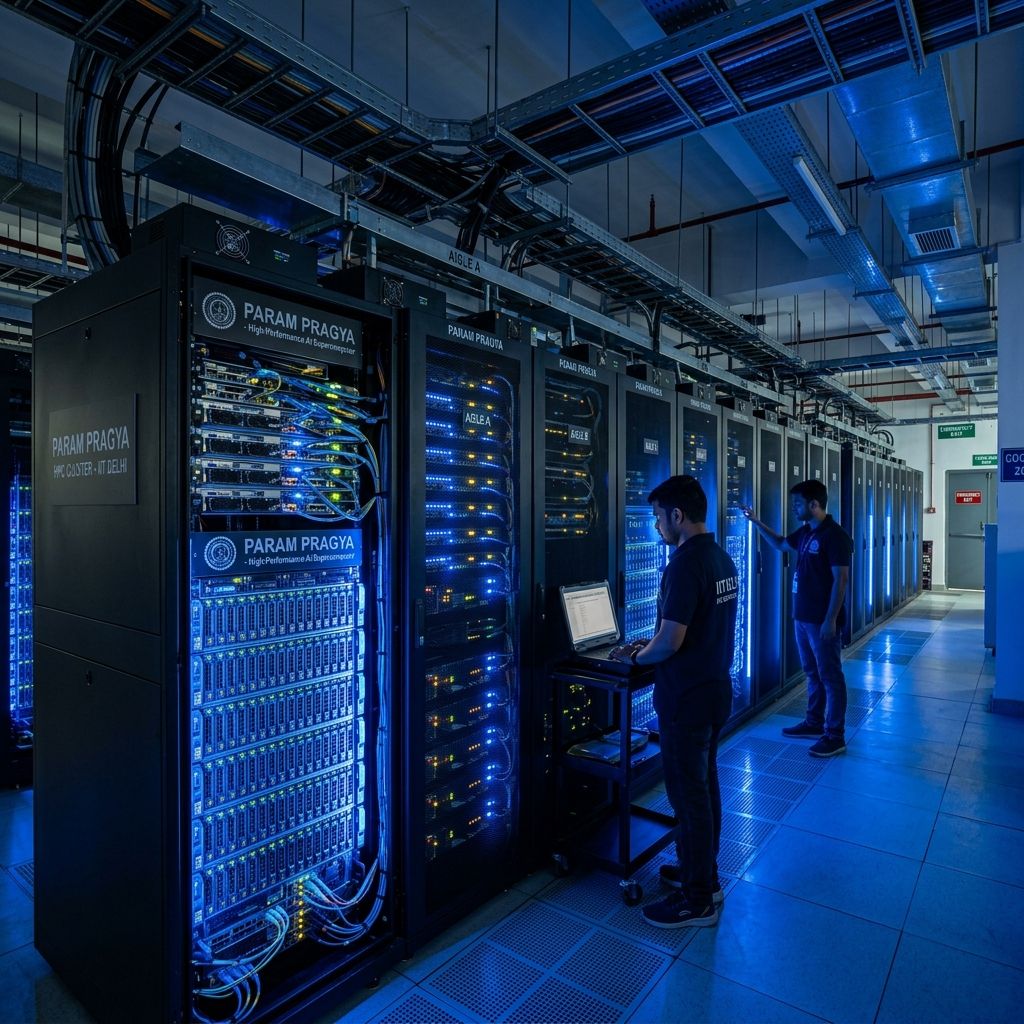
Marking a giant leap in India's Artificial Intelligence (AI) and High-Performance Computing (HPC) ecosystem, Prime Minister Narendra Modi inaugurated the state-of-the-art 'PARAM Pragya' AI-powered supercomputer facility.
- Inauguration: Formally launched by PM Narendra Modi on August 8, 2026, during the 57th Convocation Ceremony of IIT Delhi at its Sonipat Campus, Haryana.
- National Supercomputing Mission (NSM): Commissioned under the NSM—a joint flaghip initiative of the Department of Science & Technology (DST) and the Ministry of Electronics & Information Technology (MeitY)—implemented by C-DAC (Centre for Development of Advanced Computing).
- Project Investment: Total project cost stands at ₹135 Crore (₹110 Crore funded under NSM and ₹25 Crore contributed by IIT Delhi).
- Exam Relevance for MPPSC & UPSC: Highly essential for MPPSC Mains (Paper 3 Unit 7 & 10) and UPSC GS-3 Science & Tech coverage on indigenous AI infrastructure.
| Parameter | Details |
|---|---|
| Facility Name | PARAM Pragya AI Supercomputer |
| Inauguration Date & Host | August 8, 2026 by PM Narendra Modi |
| Location | IIT Delhi Sonipat Campus, Haryana |
| Compute Capacity | ~250 AI Petaflops (PF) / 8 PF Conventional |
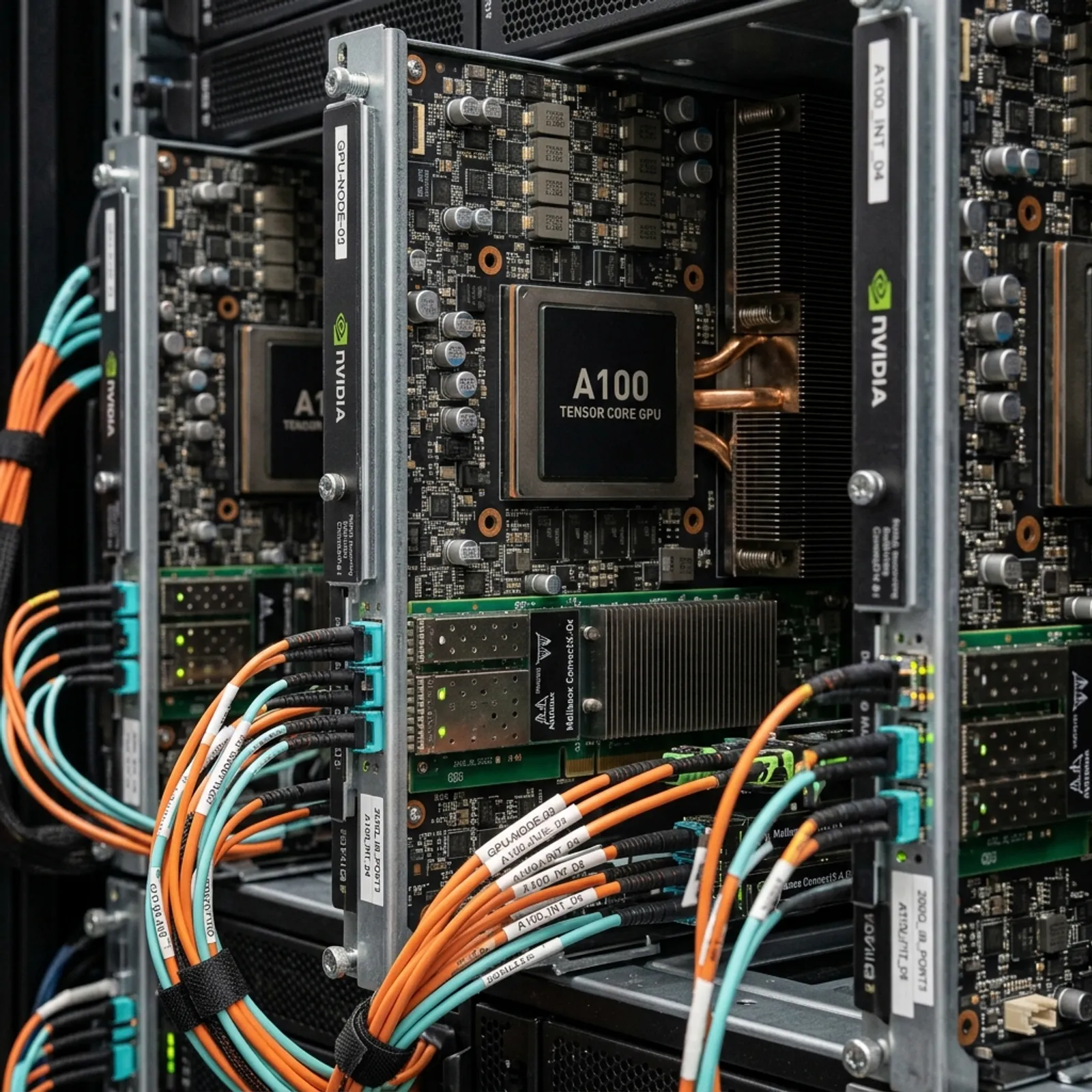
| GPU Architecture | 400 NVIDIA A100 (80GB) Tensor Core GPUs |
| Storage Capacity | 10 Petabytes (PB) Parallel File System |
| Nodal Framework | National Supercomputing Mission (NSM) |
| Implementing Agency | C-DAC (Pune) & IIT Delhi |
| Project Cost | ₹135 Crore (₹110 Cr NSM + ₹25 Cr IIT Delhi) |
| Open Access Policy | 40% capacity allocated to external researchers & startups |
PARAM Pragya: Technical Architecture & Key Specifications
'PARAM Pragya' has been custom-engineered for deep AI training, Large Language Models (LLMs), and compute-intensive scientific applications:
1. 250 AI Petaflops Compute Power
- What is a Petaflop?: One petaflop equals 10^15 (1 quadrillion) floating-point operations per second.
- AI Performance: Delivers ~250 AI Petaflops of AI mixed-precision performance alongside 8 Petaflops of conventional HPC compute.
2. Cluster of 400 NVIDIA A100 GPUs
- Hardware Architecture: Incorporates 400 NVIDIA A100 (80GB) Tensor Core GPUs interconnected via ultra-high bandwidth NVLink fabrics.
- Deep Learning Efficiency: Enables training of multi-billion parameter AI models at unprecedented speeds.
3. 10 Petabytes Parallel Storage
- Data Subsystem: Equipped with a 10 PB Parallel File System allowing instantaneous multi-gigabyte data throughput across nodes.
4. Green Data Center & Energy Efficiency
- Power Profile: Operates within an optimized 800 kW energy envelope utilizing advanced liquid cooling solutions to minimize carbon footprint.
5. 40% External Research Access
- Democratizing AI Compute: In line with NSM guidelines, 40% of compute cycles are explicitly reserved for non-IIT Delhi scholars, research labs, and Indian deep-tech startups.

India's Supercomputing Journey: From PARAM 8000 (1991) to PARAM Pragya (2026)
India's supercomputing saga is a shining testament to scientific perseverance, political resolve, and technological self-reliance:
1. The 1980s US Technology Embargo (Cray Denial)
- Historical Background: In the late 1980s, India sought to purchase a Cray X-MP supercomputer from the US for weather forecasting.
- Sanctions: Fearing potential dual-use applications in nuclear research, the US government denied the export license to India.
2. Establishment of C-DAC & Dr. Vijay Bhatkar (1988)
- Creation of C-DAC: In response, the Government of India established C-DAC (Centre for Development of Advanced Computing) in Pune in 1988.
- Father of Indian Supercomputing: Renowned scientist Dr. Vijay Bhatkar spearheaded the indigenous supercomputing mission.
3. Launch of 'PARAM 8000' (1991)
- First Indigenous Supercomputer: In 1991, C-DAC successfully unveiled PARAM 8000, surprising the global scientific community.
- Global Recognition: Built at a fraction (1/28th) of the cost of a Cray machine, PARAM 8000 was exported to Germany, UK, and Russia.
4. Key Milestones in India's Supercomputing History
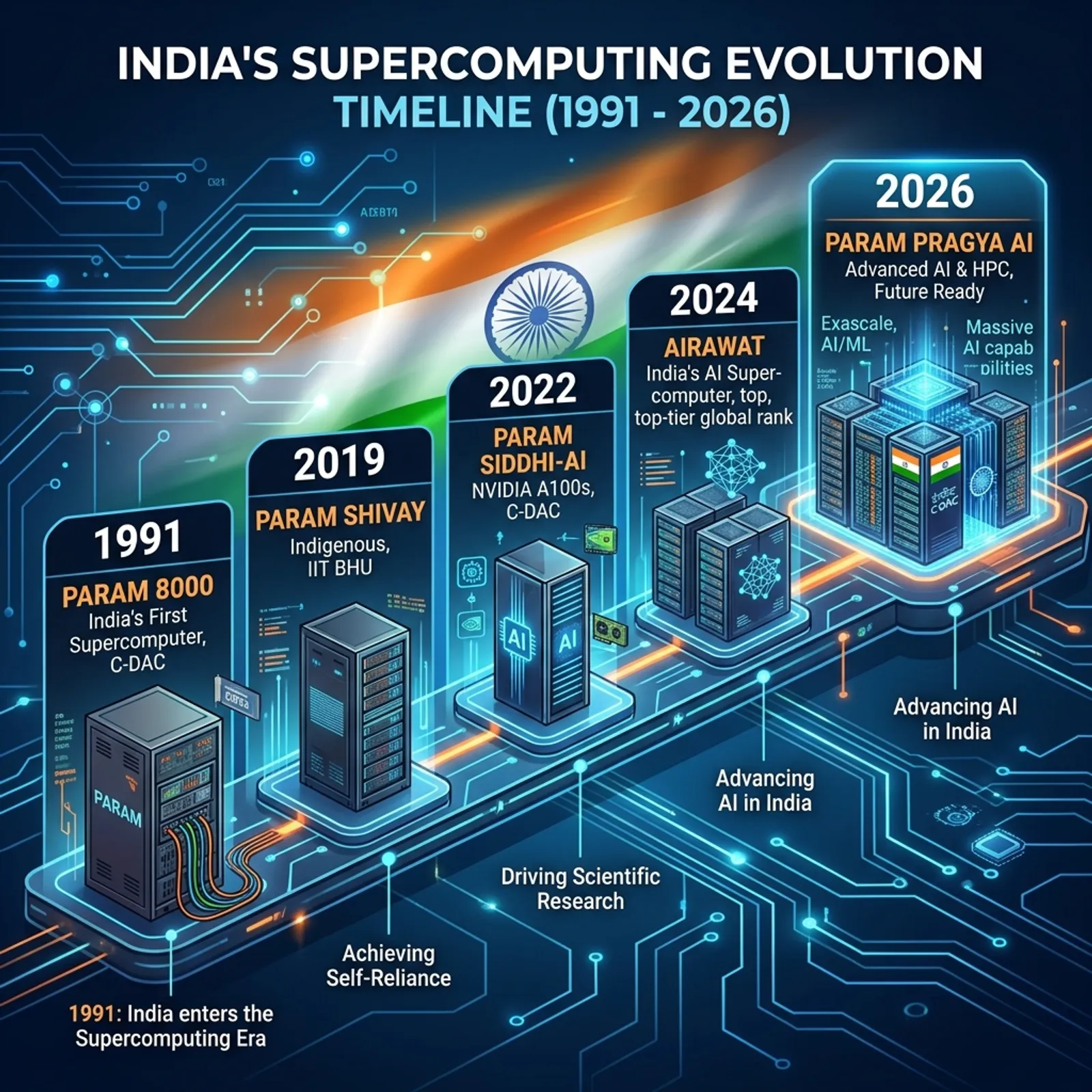
- PARAM 8000 (1991): India's 1st indigenous supercomputer (1 Gigaflop speed).
- PARAM Padma (2002): First Indian system to break the 1 Teraflop barrier.
- PARAM Yuva / Yuva II (2008-2013): High-efficiency green supercomputers ranked globally.
- PARAM Shivay (2019): First supercomputer deployed under NSM at IIT BHU.
- PARAM Siddhi-AI (2020): Reached Rank 62 in TOP500 globally with 210 AI Petaflops.
- AIRAWAT (2023): C-DAC Pune's AI supercomputer ranked 75th globally.
- PARAM Rudra (2024): High-performance NSM nodes deployed across Pune, Delhi, and Kolkata.
- PARAM Pragya (2026): Latest 250 AI Petaflops flagship AI facility inaugurated at IIT Delhi Sonipat.

🔗 संबंधित विस्तृत अध्ययन सामग्री: सुपरकंप्यूटर क्या है? उपयोग, विशेषताएँ, इतिहास और भारत के प्रमुख सुपरकंप्यूटर (Complete Study Guide)
Read our comprehensive guide on Supercomputing history, PARAM 8000, FLOPS, National Supercomputing Mission & World TOP500 rankings: Supercomputers Complete Study Notes
National Supercomputing Mission (NSM) & Role of C-DAC
What is National Supercomputing Mission (NSM)?
- Launch Year: Launched in 2015 with a total outlay of ₹4,500 Crore to bolster India's HPC infrastructure.
- Nodal Ministries: Jointly driven by Department of Science & Technology (DST) and Ministry of Electronics & IT (MeitY).
- Executing Entities: Centre for Development of Advanced Computing (C-DAC) and Indian Institute of Science (IISc Bengaluru).
- Core Mandate: Connecting academic and scientific institutions via the National Knowledge Network (NKN) HPC grid.
The 3 Phases of NSM
- Phase 1: Assembling supercomputing systems using imported components.
- Phase 2: Manufacturing motherboards, chassis, and liquid-cooling hardware domestically.
- Phase 3: Developing 100% indigenous supercomputers utilizing India's own Rudra server platforms and Trinetra interconnects.
Applications & Strategic Significance of PARAM Pragya
PARAM Pragya serves as a vital catalyst across multiple national priority domains:
1. Indic AI & Bhashini Multilingual Models
- Language Inclusion: Trains foundational AI models for Indian languages under Digital India's Bhashini initiative.
2. Healthcare & Accelerated Drug Discovery
- Biomedical Research: Rapid genomic sequencing analysis and molecular docking simulations for targeted therapeutics.
3. Climate Science & Monsoon Dynamics
- Meteorology: Enhances high-resolution weather forecasting and climate change modeling for Indian agriculture.
4. Space & Satellite Image Processing
- ISRO Earth Observation: Real-time satellite imagery analysis for disaster response and natural resource mapping.
5. Defense, Robotics & Quantum Mechanics
- Strategic Applications: Supports advanced computational fluid dynamics (CFD) for aerospace and defense research.
🔗 संबंधित विस्तृत अध्ययन सामग्री: सुपरकंप्यूटर क्या है? उपयोग, विशेषताएँ, इतिहास और भारत के प्रमुख सुपरकंप्यूटर (Complete Study Guide)
Read our comprehensive guide on Supercomputing history, PARAM 8000, FLOPS, National Supercomputing Mission & World TOP500 rankings: Supercomputers Complete Study Notes
Quick Revision Points for MPPSC & UPSC Examinations
High-Yield Facts for MPPSC & UPSC Prelims
- India's First Supercomputer → PARAM 8000 (Built by C-DAC in 1991)
- Father of Indian Supercomputing → Dr. Vijay Bhatkar
- C-DAC Headquarters → Pune, Maharashtra
- PARAM Pragya Location → IIT Delhi Sonipat Campus, Haryana
- PARAM Pragya Compute Capacity → ~250 AI Petaflops (400 NVIDIA A100 GPUs)
- National Supercomputing Mission Launch → 2015 (Joint DST & MeitY initiative)
- India's 1st Dedicated AI Supercomputer → PARAM Siddhi-AI (2020)
- Global Supercomputer Ranking → TOP500 List (Published biannually)
Crucial Abbreviations
- C-DAC: Centre for Development of Advanced Computing
- HPC: High-Performance Computing
- NSM: National Supercomputing Mission
- Petaflop: 10^15 Operations Per Second
- FLOPs: Floating-Point Operations Per Second
Mains Answer Writing Booster Capsule
"India's trajectory from PARAM 8000 (1991) to PARAM Pragya (2026) represents a transition from technological denial to self-reliant AI dominance, cementing India's stature as a global leader in High-Performance Computing and indigenous AI infrastructure."
Read More:भारत में सुपर कंप्यूटर: जनक, इतिहास, सूची व विशेषताएँ | MPPSC & UPSC Notes (Supercomputers in India)
Practice Questions
1Where has the AI supercomputer 'PARAM Pragya', inaugurated in August 2026, been established?
2What is the total AI compute capacity of the PARAM Pragya supercomputer?
3In which year was India's first indigenous supercomputer 'PARAM 8000' launched?
4Who is known as the 'Father of Indian Supercomputing'?
5In which year was the National Supercomputing Mission (NSM) launched?
6What percentage of PARAM Pragya's total computing capacity has been reserved for external researchers and startups?
7Where is the headquarters of C-DAC (Centre for Development of Advanced Computing) located?
81 Petaflop represents the capability to perform how many Floating-Point Operations per second?
Frequently Asked Questions
Article Sources
3 sources
Article Sources
3 sources