
Supercomputers in India: History, Father of Supercomputing, Full List & Specs | MPPSC & UPSC Notes
Complete study guide covering Father of Indian Supercomputing Dr. Vijay Bhatkar, PARAM 8000 (1991), C-DAC, National Supercomputing Mission (NSM), AIRAWAT (Rank 75), and PARAM Pragya (250 AI Petaflops).

Supercomputers in India: Key Facts & Overview
1. Which is the fastest supercomputer in India currently?
- Answer: Currently, PARAM Pragya (250 AI Petaflops launched at IIT Delhi Sonipat in 2026) and AIRAWAT – PSAI (13.17 Petaflops peak at C-DAC Pune, ranked 75th globally in June 2023 TOP500) are India's fastest AI supercomputing systems.
2. Who is known as the Father of Indian Supercomputing?
- Answer: Dr. Vijay Bhatkar is recognized as the Father of Indian Supercomputers. He led C-DAC to build India's 1st indigenous supercomputer PARAM 8000 in 1991.
3. How many supercomputers are there in India?
- Answer: India operates over 15 major HPC supercomputers under the National Supercomputing Mission (NSM) across premier institutes like IITs, IISc, and C-DAC, with 4 systems listed in global TOP500.
4. Which organization/company builds supercomputers in India?
- Answer: C-DAC (Centre for Development of Advanced Computing, Pune) is the premier nodal agency building indigenous supercomputers in India under MeitY and DST.
5. What is the history of supercomputing in India and when was the first supercomputer built?
- Answer: Triggered by the 1987 US denial of Cray X-MP exports, India established C-DAC in 1988 and successfully developed PARAM 8000 in 1991.
| Supercomputer | Location & Year | Capacity / Rank | Key Highlight |
|---|---|---|---|
| PARAM 8000 | C-DAC Pune (1991) | GigaFLOPS Range | India's First Indigenous Supercomputer |
| AIRAWAT – PSAI | C-DAC Pune (2023) | 13.17 Petaflops (Rank 75) | Highest Ranked Indian System in TOP500 |
| PARAM Siddhi-AI | C-DAC Pune (2020) | 5.27 Petaflops (Rank 131) | India's 1st Dedicated AI Supercomputer |
| PARAM Pragya | IIT Delhi Sonipat (2026) | 250 AI Petaflops | Flagship AI Supercomputer with 400 A100 GPUs |
| Pratyush | IITM Pune | 4.01 Petaflops (Rank 169) | Monsoon & Climate Research |
| Mihir | NCMRWF Noida | 2.81 Petaflops (Rank 316) | Medium-Range Weather Prediction |
What is a Supercomputer? Overview & Performance Metrics
Supercomputers are high-performance computing systems explicitly engineered to process extremely complex, large-scale mathematical computations at extraordinary speeds. Their computational capacity exceeds standard commercial personal computers by several orders of magnitude.
- Performance Metric: The computational speed of a supercomputer is measured in FLOPS (Floating-Point Operations Per Second), representing the number of floating-point arithmetic calculations executed per second.
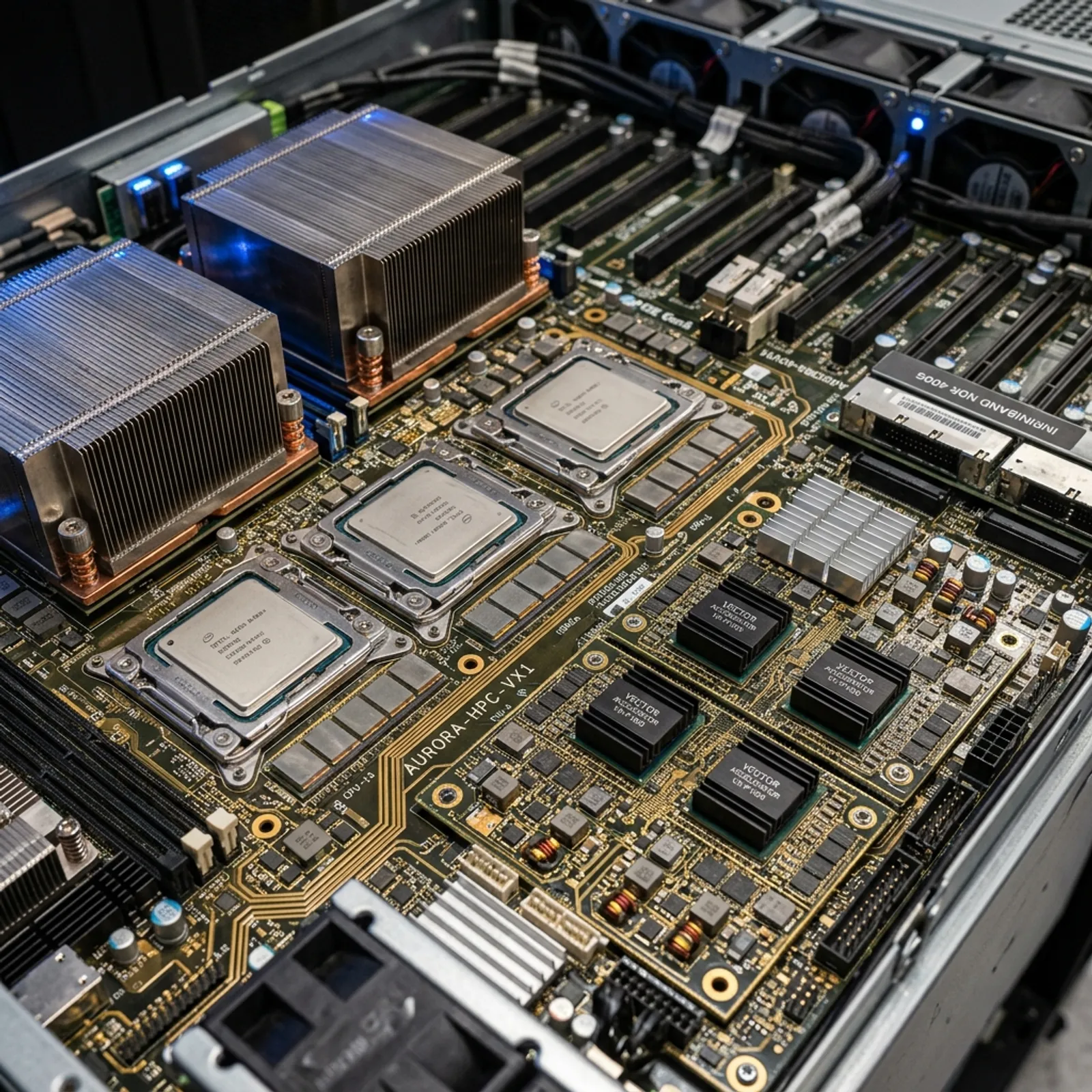
- Parallel Processing Architecture: Employs thousands of interconnected CPUs and GPU processing units operating simultaneously. Large computational workloads are decomposed into smaller sub-tasks processed in parallel.
- Specialized Purpose Computers: Apart from general scientific research, specialized supercomputers have been developed for targeted tasks—such as Belle, Hydra, and Deep Blue designed for playing grandmaster chess.
- MPPSC & UPSC Exam Relevance: Vital for MPPSC Mains (Paper 3 Unit 7 & 10 - ICT) and UPSC GS-3 Science & Technology syllabus.
| Parameter | Details |
|---|---|
| Unit of Performance | FLOPS (Floating-Point Operations Per Second) |
| Core Characteristic | High Computation Speed & Parallel Processing |
| Processing Architecture | Multiple CPUs / Processing Units / GPUs |
| India's Flagship Program | National Supercomputing Mission (NSM) |
| NSM Announcement | 2015 (Outlay: ₹4,500 Crore / $730 Million) |
| Implementing Agencies | C-DAC (Pune) & IISc (Bengaluru) |
| India's PARAM Series | Indigenous Supercomputer Series developed by C-DAC |
| PARAM 8000 Launch | 1991 (India's First Indigenous Supercomputer) |
| PARAM 9000 Series | 1993 (Peak Computing Power: 5 GFLOPS) |
| PARAM 10000 Series | 1998 (Sustained Performance: 38 GFLOPS) |
| India's Major Supercomputers | AIRAWAT, PARAM Siddhi-AI, Pratyush, Mihir, PARAM Pragya |
Key Features & Architectural Characteristics of Supercomputers
The architectural foundations that distinguish supercomputers from standard computing systems include:
1. Multiple CPUs & Parallel Processing
- Architecture: Houses thousands of high-performance CPUs and GPUs working synchronously. Each unit handles arithmetic and logic pipeline execution.
2. Extreme Computation Speed
- High Throughput: Capable of executing quadrillions of floating-point operations per second to complete massive datasets in real time.
3. High Storage Capacity & Throughput
- Parallel Storage: Incorporates multi-petabyte parallel file systems ensuring rapid data access and instruction retrieval across nodes.
4. Vector Arithmetic Capability
- Vector Operations: Processes entire numerical lists and matrix arrays simultaneously rather than operating on isolated scalar numbers.
5. Multi-User Shared Infrastructure
- Resource Sharing: Supports concurrent high-priority execution threads for hundreds of multi-disciplinary researchers globally.
Global History of Supercomputing & World's Top Supercomputers
Evolution of Global Supercomputing
High-performance computing accelerated in the late 1950s, driven by US defense and scientific research funding:
- 1976 - Cray-1: Designed by Seymour Cray, Cray-1 pioneered commercial vector processing architecture.
- 1985 - Cray-2: A 4-processor supercomputer that became the first system to break the 1 Gigaflop (1 Billion FLOPS) speed barrier.
- 2008 - IBM Roadrunner: Became the first supercomputer to break the 1 Petaflop (1,000 TFLOPS) barrier.
World's Leading Supercomputing Systems
- LineShine (China): Ranked as a top global system in 2026 reaching a peak throughput of 2.19 Exaflops.
- El Capitan (United States): Located at Lawrence Livermore National Laboratory (LLNL), powered by AMD architecture.
- Frontier (United States): Premier exascale system deployed at Oak Ridge National Laboratory (ORNL).
- Aurora (United States): Intel-based exascale system operating at Argonne National Laboratory.
- Fugaku (Japan): Situated at RIKEN Center for Computational Science in Kobe, Japan.
Global Geographic Distribution
- United States: Leads the biannual TOP500 list with maximum aggregate computational capacity.
- China: Holds the second largest aggregate compute footprint globally.
- Europe & Japan: Deploys cutting-edge HPC grids across Germany, Italy, Switzerland, and Japan for AI and climate modeling.
⚡ नवीनतम समसामयिकी (Current Affairs): भारत का नया AI सुपरकंप्यूटर 'परम प्रज्ञा' (PARAM Pragya AI Supercomputer) — विस्तृत विश्लेषण
Explore dedicated coverage on India's latest 250 AI Petaflops PARAM Pragya supercomputer inaugurated at IIT Delhi Sonipat Campus: PARAM Pragya AI Supercomputer Detailed Notes
Supercomputing Development in India & Key Scientific Institutions
Historical Background: The 1987 US Embargo
India's supercomputing program gained decisive momentum after the US government denied the export of the Cray X-MP supercomputer to India in 1987. India urgently required the system for weather forecasting and academic research.
This embargo impelled India to embark on a self-reliant path to build indigenous supercomputing infrastructure.
Major Indian Institutions & Indigenous Series
- C-DAC (Centre for Development of Advanced Computing): Established in 1988 in Pune; pioneered the famous PARAM series.
- BARC (Bhabha Atomic Research Centre): Developed the Anupam supercomputer series for nuclear modeling.
- ANURAG (DRDO): Designed the PACE series for defense and ballistic applications.
- C-DOT: Developed CHIPPS, a high-performance Parallel Processing System.
- NAL (National Aerospace Laboratories): Engineered parallel systems for aerodynamics.
| Institution | Supercomputer Series | Primary Focus Area |
|---|---|---|
| C-DAC (Pune) | PARAM Series | National HPC Grid & AI Research |
| BARC (Mumbai) | Anupam Series | Nuclear Physics & Molecular Modeling |
| ANURAG (DRDO) | PACE Series | Defense & Aerospace Simulations |
| C-DOT (Delhi) | CHIPPS Architecture | Telecommunications & Parallel Systems |
| NAL (Bengaluru) | Flosolver Series | Aeronautics & Computational Fluid Dynamics |
Evolution of C-DAC's PARAM Series
PARAM signifies "Supreme" in Sanskrit and stands for PARAllel Machine:
- PARAM 8000 (1991): India's 1st indigenous parallel supercomputer (GigaFLOPS range).
- PARAM 9000 (1993): Delivered peak computing power of 5 GFLOPS.
- PARAM 10000 (1998): Achieved sustained performance of 38 GFLOPS on LINPACK benchmarks.
Indian Supercomputers in TOP500 & National Supercomputing Mission (NSM)
Indian Supercomputers in Global TOP500 (June 2023 Data)
According to the official TOP500 supercomputing ranking, India featured 4 prominent systems:
| Rank | Site | Supercomputer System | Rmax (TFLOPS) | Rpeak (TFLOPS) |
|---|---|---|---|---|
| 75 | C-DAC Pune | AIRAWAT – PSAI | 8.50 | 13.17 |
| 131 | C-DAC Pune | PARAM Siddhi-AI | 4.62 | 5.27 |
| 169 | IITM Pune | Pratyush (Cray XC40) | 3.76 | 4.01 |
| 316 | NCMRWF Noida | Mihir (Cray XC40) | 2.57 | 2.81 |
National Supercomputing Mission (NSM)
- Launch & Outlay: Announced in 2015 jointly by MeitY and DST with an outlay of ₹4,500 Crore ($730 Million).
- Objective: Connecting 73 academic and research institutions via the National Knowledge Network (NKN) HPC grid.
- Key Deployed Systems: PARAM Shivay (IIT BHU - 1st NSM node in 2020), PARAM Pravega (IISc), PARAM Ananta (IIT Gandhinagar), PARAM Himalaya (IIT Mandi).
⚡ नवीनतम समसामयिकी (Current Affairs): भारत का नया AI सुपरकंप्यूटर 'परम प्रज्ञा' (PARAM Pragya AI Supercomputer) — विस्तृत विश्लेषण
Explore dedicated coverage on India's latest 250 AI Petaflops PARAM Pragya supercomputer inaugurated at IIT Delhi Sonipat Campus: PARAM Pragya AI Supercomputer Detailed Notes
Special Interlinked Coverage: 'PARAM Pragya' AI Supercomputer (2026)
India's Latest 250 AI Petaflops Supercomputer: PARAM Pragya
In August 2026, Prime Minister Narendra Modi inaugurated PARAM Pragya at IIT Delhi Sonipat Campus.
- Compute Speed: ~250 AI Petaflops powered by 400 NVIDIA A100 GPUs.
- Read Complete Coverage: Explore our dedicated deep-dive article on PARAM Pragya:
⚡ नवीनतम समसामयिकी (Current Affairs): भारत का नया AI सुपरकंप्यूटर 'परम प्रज्ञा' (PARAM Pragya AI Supercomputer) — विस्तृत विश्लेषण
Explore dedicated coverage on India's latest 250 AI Petaflops PARAM Pragya supercomputer inaugurated at IIT Delhi Sonipat Campus: PARAM Pragya AI Supercomputer Detailed Notes
Applications, Advantages & Limitations of Supercomputers
Key Applications of Supercomputers
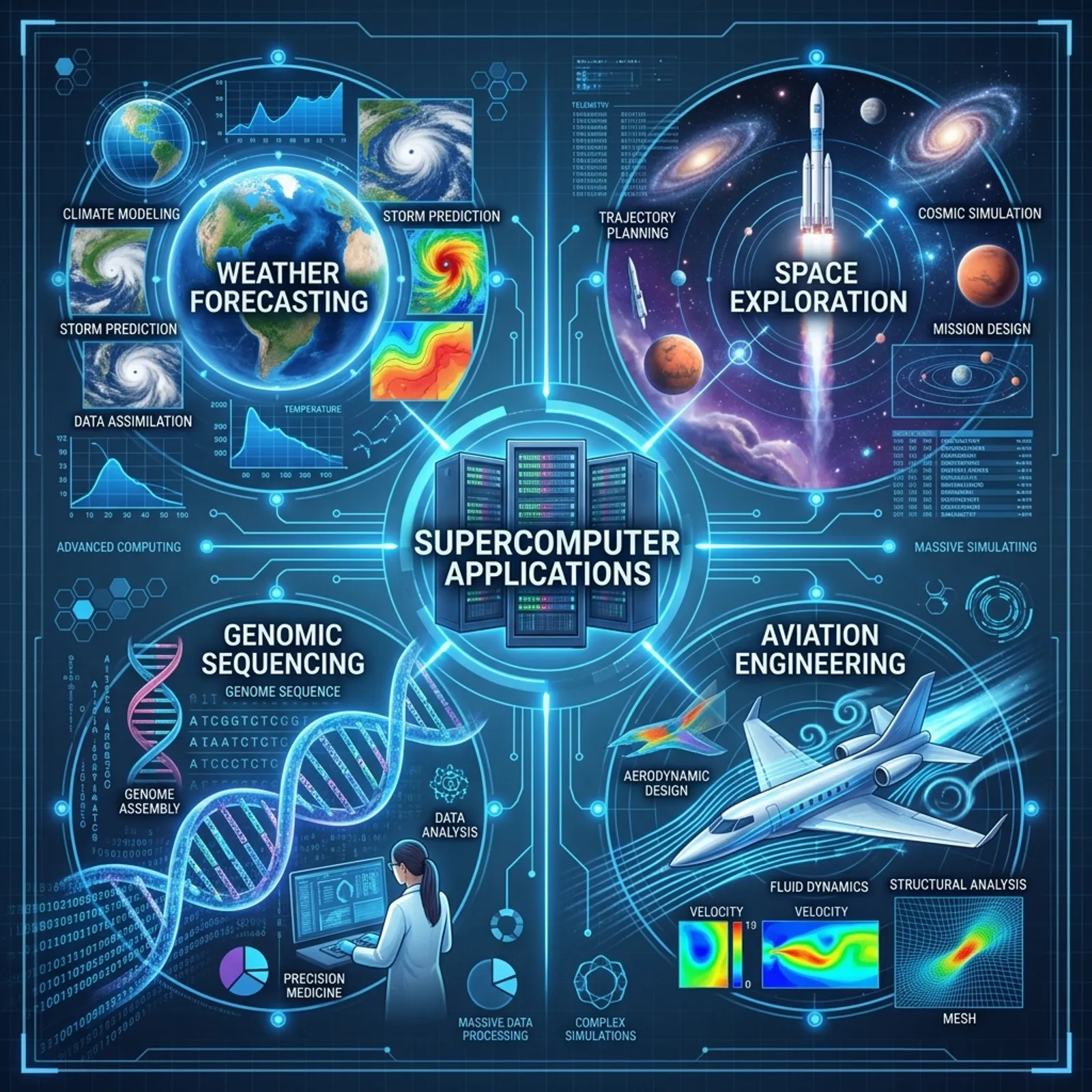
- 1. Weather & Climate Modeling: Processing global satellite data for severe weather and monsoon predictions.
- 2. Genomic Sequencing & Medicine: Molecular modeling and rapid DNA sequencing.
- 3. Aviation Engineering: Aerodynamic turbulence testing and open fan engine simulations.
- 4. Space Exploration: NASA's Aitken supercomputer supporting Artemis Moon missions.
- 5. Nuclear Fusion Research: Plasma containment simulations using Frontier and Summit.
- 6. Oil & Gas Exploration: Processing massive 3D seismic geophysical datasets.
- 7. Defense Simulations: Virtual nuclear explosion testing and ballistic missile trajectory calculation.
- 8. Pollution & Smog Prediction: Predicting regional air quality and smog distribution.
Limitations & Technical Challenges
- 1. Enormous Physical Footprint: Requires over 1,000 sq ft dedicated cleanroom facilities.
- 2. High Maintenance Costs: Demands specialized parallel operating systems and engineering expertise.
- 3. Massive Heat Generation: Demands active liquid-cooling infrastructure.
- 4. Extreme Power Consumption: Consumes average of 4 Megawatts (MW) of electricity.
MPPSC & UPSC Quick Revision: Key Facts & One-Liners
High-Yield Facts for MPPSC & UPSC Prelims
- 1987 → US embargo denying Cray X-MP export to India.
- C-DAC → Nodal agency behind PARAM series (HQ: Pune).
- PARAM → Acronym for PARAllel Machine & Sanskrit for 'Supreme'.
- PARAM 8000 → 1991 (India's 1st indigenous supercomputer).
- National Supercomputing Mission → 2015 (₹4,500 Crore outlay).
- PARAM Shivay → 1st NSM supercomputer (2020 at IIT BHU).
- AIRAWAT → Ranked 75 in June 2023 TOP500 list.
- PARAM Pragya → 250 AI Petaflops supercomputer at IIT Delhi Sonipat (2026).
Mains Answer Booster Capsule
"Supercomputing forms the technological cornerstone for weather modeling, genomics, defense simulations, and AI sovereignty, driving India's journey towards scientific self-reliance."
Practice Questions
1In which unit is the performance of a supercomputer measured?
2India's first indigenous supercomputer 'PARAM 8000' was developed by which organization?
3In which year was the National Supercomputing Mission (NSM) launched?
4Which was the first supercomputer deployed under NSM and where was it installed?
5What was the rank of India's AIRAWAT supercomputer in the June 2023 TOP500 list?
6Which country denied the sale of Cray X-MP supercomputer to India in 1987?
7Which organization developed the 'Anupam' series of supercomputers for nuclear research?
8What is the name of the 250 AI Petaflops supercomputer inaugurated at IIT Delhi Sonipat Campus in August 2026?
Frequently Asked Questions
Article Sources
3 sources
Article Sources
3 sources
साझा करें
Related Articles

Asian Games 2026 Medal Tally: India's 19 Medals (2 Gold, 8 Silver, 9 Bronze), Complete Winners Table & Sport-wise List | MPPSC & UPSC Sports Notes
At the 2026 Asian Games in Aichi-Nagoya, Japan, Team India has clinched a total of 19 medals (2 Gold, 8 Silver, 9 Bronze). Indian Women's Cricket Team and Shooters Suruchi & Kamaljeet secured Gold Medals. Explore the complete medal tally, sport-wise breakdown, and full winners list.

72nd National Film Awards 2026 Winners List Hindi: 2024 Winners Table, Filmfare Awards Comparison & MPPSC / UPSC Exam Notes
Complete 72nd National Film Awards 2026 Winners List in Hindi & English for 2024 certified films. 'Article 370' wins Best Feature Film, Kartik Aaryan & Mammootty win Best Actor, Yami Gautam wins Best Actress. Includes full winners table, Filmfare Awards comparison, and 8 practice MCQs for MPPSC & UPSC.

IPS Sanjukta Parashar Appointed First Female IG of CRPF CoBRA: Career Profile, Security Forces & Exam Notes
IPS officer Dr. Sanjukta Parashar (2006 batch, Assam-Meghalaya cadre) has been appointed as the first woman Inspector General (IG) of CRPF CoBRA (Commando Battalion for Resolute Action). Read her career profile, CoBRA operational role, and key exam notes.
Join Aakar IAS Community
Get daily Current Affairs PDFs directly on your WhatsApp, or join our official Telegram & WhatsApp channels.