
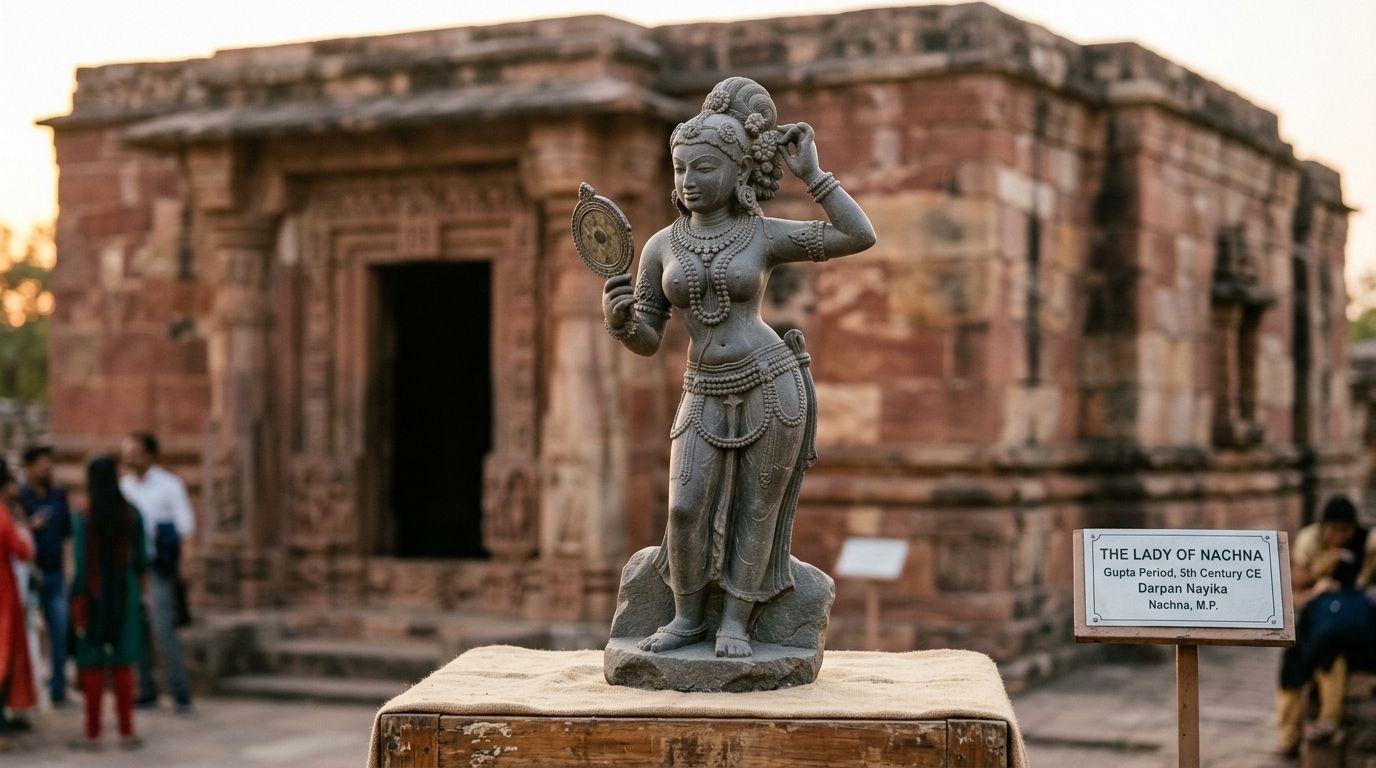
‘Lady of Nachna’: 1,500-Year-Old Gupta Period Sculpture Discovered in Panna, Parvati Temple & Exam Notes | MPPSC & UPSC
In November 2026, the Archaeological Survey of India (ASI) unearthed a pristine 1,500-year-old Gupta-era grey sandstone sculpture titled the 'Lady of Nachna' from a depth of 4 feet at Nachna Kuthara, Panna district (Madhya Pradesh). Depicting a graceful nayika adorning her hair with an ancient hair-clip and saptaladi necklace, this discovery revolutionizes our understanding of 5th-century classical Indian art. Includes architectural analysis of Parvati & Chaumukhnath temples, Gyaraspur comparison, and 8 practice MCQs for MPPSC & UPSC.

1. Discovery & Historical Context of Lady of Nachna
Historic Archaeological Excavation in Panna, Madhya Pradesh
- Provenance & Excavation: In November 2026, the Archaeological Survey of India (ASI) unearthed an exquisite ancient sculpture, formally designated the 'Lady of Nachna', from a depth of approximately 4 feet underground during systematic scientific excavations at Nachna (Nachna Kuthara) village in Saleha tehsil, Panna district, Madhya Pradesh.
- Chronological Dating (Gupta Era): Stylistic and stratigraphical analysis dates the sculpture to the 4th to 5th Century CE (approx. 1,500 years old - Classical Gupta Period), universally celebrated as the 'Golden Age' of classical Indian plastic art and architecture.
- Unbroken Freestanding State: Unlike typical architectural temple fragments or structural friezes, this sculpture is a complete, independent, freestanding artifact preserved in near-pristine condition after 15 centuries.
- Syllabus Mapping: Crucial for MPPSC Prelims Paper 1 Unit 2 (History, Culture & Architecture of MP) and MPPSC Mains Paper 1 Part A.
2. Anatomical Structure & Artistic Excellence of Lady of Nachna
Dimensions, Medium & Classical Gupta Polish
- Dimensions & Medium: Standing approximately 20 centimeters (about 8 inches) in height, carved meticulously from fine-grained grey sandstone. The surface retains the radiant, porcelain-like mirror polish characteristic of peak Gupta ateliers.
- Secular Nayika Adorning Herself: Departing from divine or celestial iconography, it depicts a secular mortal maiden (nayika) engaged in the intimate act of self-adornment (prasadhan / shringar), reflecting aesthetic consciousness and realistic feminine agency in classical India.
- Intricate Classical Ornaments: Adorned with a delicate seven-strand beaded pearl necklace (saptaladi haar), circular ear kundalas, sculpted armlets (keyura), and wrist bangles (kankana).
- The Ancient 'Hair Clip' Sensation: The crowning artistic highlight is her elaborate coiffure. Her gathered tresses are secured with a distinctly carved decorative hair clip, providing physical archaeological proof that modern hair-clasping accoutrements were in active fashionable use in 5th-century India.
3. Archaeological Significance & Comparative Art History
First-of-its-Kind Secular Discovery in Central India
- ASI Expert Endorsement: According to Dr. Shivakant Vajpayee, Superintending Archaeologist at ASI Jabalpur Circle, this is the very first freestanding sculpture unearthed in Madhya Pradesh representing a woman actively performing personal coiffure and cosmetics.
- Centuries Older than Lady of Gyaraspur: Vidisha's internationally acclaimed 9th-10th century Pratihara masterpiece, the 'Lady of Gyaraspur' (Shalabhanjika), is post-Gupta. 'Lady of Nachna' predates it by 400 to 500 years.
- Bridging Evolutionary Art Eras: Precedes the famous 10th-11th century Chandela sculptures of Khajuraho (such as the 'Sukhanaika'), providing a vital empirical link in tracking the evolution of Indian feminine aesthetics from naturalistic classical Gupta restraint to medieval ornamental dynamism.
- Museum Conservation: Currently preserved under institutional custody of the ASI for scientific stabilization and planned public exhibition.
4. Historical Landscape of Nachna Kuthara: Parvati & Chaumukhnath Temples
Nachna Kuthara: Cradle of Indian Structural Stone Architecture
- Alexander Cunningham's Survey (1883-84): The monumental significance of Nachna Kuthara was first documented scientifically by British archaeologist Sir Alexander Cunningham during his seminal Central India archaeological surveys in 1883-84.
1. Parvati Temple (c. 465 CE)
- Earliest Surviving Stone Temple: Among the earliest standing structural stone temples in Indian architectural history.
- Vakataka Feudatory Inscription: Built around 465 CE during the Gupta epoch by feudatory chieftain Vyaghradeva, subordinate to the Vakataka dynasty, as confirmed by epigraphical records found at the site.
- Flat Roof & Perforated Trellises: Elevated on a high molded stone plinth (jagati) with western stairs. Features a flat roof with a smaller upper story sanctum chamber and an enclosed ambulatory circumambulatory path (pradakshina-patha) illuminated by pierced stone lattice windows (gavakshas).
- Earliest Ramayana Narrative Reliefs: The temple doorway displays river goddesses Ganga and Yamuna. Its plinth moldings bear the earliest known sculpted Ramayana narrative panels in Indian art (including the Surpanakha mutilation, Ravana's abduction of Sita, and Jatayu's valor).
2. Chaumukhnath Temple (Chaturmukha Mahadev)
- Evolution of the Nagara Shikhara: Adjoining the Parvati temple, it traces the historical evolution from flat roof sanctums to towering Nagara curvilinear shikharas. Founded in the 5th century Gupta era, its upper superstructure was augmented during the 7th-9th centuries under Pratihara/Kalachuri regimes.
- Rare Four-Faced Shiva Lingam: Houses a colossal 5th-century Chaturmukha Shiva Lingam, capturing four cosmic manifestations of Shiva: Sadyojata, Vamadeva, Aghora (fierce Bhairava), and Tatpurusha with sublime spiritual serenity.
5. Comparative Analysis Tables: Nachna Temples & Iconic Sculptures
Table 1: Comparative Analysis of Nachna Temples (Parvati vs Chaumukhnath)
| Feature | Parvati Temple | Chaumukhnath Temple |
|---|---|---|
| Period of Construction | 5th Century CE (c. 465 CE - Classical Gupta) | Core: 5th Century CE; Shikhara: 7th–9th Century CE |
| Principal Presiding Deity | Goddess Parvati (or Shiva-Parvati) | Chaturmukha Shiva Lingam (Four-Faced Shiva) |
| Roof Superstructure | Flat roof with miniature upper sanctum chamber | Towering Curvilinear Nagara Shikhara |
| Architectural Highlights | High Jagati plinth, covered pradakshina-patha, pierced gavakshas | Transition to mature Nagara temple plan with external friezes |
| Artistic Masterpiece | Ganga-Yamuna dvarashakhas & earliest Ramayana reliefs | Majestic Four-Faced Chaturmukha Shiva Lingam |
| Epigraphical Record | Inscribed records of Vakataka vassal Vyaghradeva | Evolution from Late Gupta to Pratihara/Kalachuri idiom |
| Statutory Protection | Protected Monument of National Importance (ASI) | Protected Monument of National Importance (ASI) |
Table 2: Comparative Study: Lady of Nachna vs Lady of Gyaraspur (Shalabhanjika)
| Feature | Lady of Nachna | Lady of Gyaraspur (Shalabhanjika) |
|---|---|---|
| Findspot & District | Nachna Kuthara (Panna District, Madhya Pradesh) | Gyaraspur (Vidisha District, Madhya Pradesh) |
| Chronological Era | 4th–5th Century CE (Classical Gupta Period) | 9th–10th Century CE (Pratihara Period) |
| Antiquity Differential | Approximately 400 to 500 years older than Gyaraspur | Represents mature medieval North Indian sculpture |
| Dimensions & Format | Compact 20 cm (8 inch) freestanding independent sculpture | Monumental architectural bracket figure from a temple pillar |
| Pose & Subject Matter | Secular Nayika engaged in intimate personal coiffure/adornment | Celestial Shalabhanjika/Apsara in dynamic Tribhanga dance posture |
| Stone & Polishing | Grey Sandstone with high lustrous classical Gupta glaze | Buff Sandstone with deeply undercut ornamental relief |
| Defining Attributes | Prominent carved hair clip and delicate seven-strand necklace | Enigmatic 'Indian Mona Lisa' smile and lavish jewel ornamentation |
| Current Repository | Excavated Nov 2026; housed under ASI institutional custody | Preserved and displayed at Gujari Mahal Museum, Gwalior Fort |
| Aesthetic Significance | Exemplifies Gupta naturalistic balance, modesty & proportion | Exemplifies medieval ornamentation, movement & baroque luxury |
6. Evolution of Indian Plastic Art & Scientific Conservation
- Evolutionary Paradigm: The Lady of Nachna embodies classical Gupta naturalism, restrained grace, and organic proportionality, whereas the Lady of Gyaraspur embodies mature medieval Pratihara ornamentation, dynamic curvature, and elaborate jewelry.
- Epigraphical & Architectural Interlinking: For an integrated perspective on ancient Central Indian epigraphy and architecture, explore our study notes on Ancient Inscriptions and Stupas of India.
- Cultural Synthesis: Paralleling tribal living heritage like the Baiga Tribe of MP and the record-setting Assam Karbi Folk Dance Nimso Kerung, Nachna represents the zenith of classical stone art.
7. High-Yield Memory Points for MPPSC & UPSC Aspirants
- Artifact Designation & Date: 'Lady of Nachna' — Unearthed in November 2026.
- Excavation Provenance: Nachna Kuthara, Saleha Tehsil, Panna District, MP (4 feet below ground).
- Excavating Agency: Archaeological Survey of India (ASI, headed by Dr. Shivakant Vajpayee).
- Chronological Horizon: 4th to 5th Century CE (Classical Gupta Period — ~1,500 years old).
- Medium & Dimensions: Grey Sandstone, 20 cm (approx. 8 inches) freestanding sculpture.
- Subject Matter: Secular Nayika engaged in personal hair coiffure & self-adornment.
- Iconic Diagnostic Features: Sculpted decorative hair clip and seven-strand beaded necklace.
- Parvati Temple Patron: Vakataka feudatory Vyaghradeva (c. 465 CE, flat-roofed style).
- Chaumukhnath Temple Highlight: Four-faced Chaturmukha Shiva Lingam with Nagara shikhara.
- First Scientific Survey: Sir Alexander Cunningham (1883-84).
Practice Questions
1In which district of Madhya Pradesh did the Archaeological Survey of India (ASI) unearth the 1,500-year-old 'Lady of Nachna' sculpture in November 2026?
2To which historical era and artistic tradition does the 'Lady of Nachna' sculpture belong?
3What is the most unique, modern-like diagnostic feature of the 'Lady of Nachna' sculpture that amazed archaeologists?
4For which distinctive architectural characteristic is the famous 5th-century 'Parvati Temple' at Nachna Kuthara renowned?
5Which earliest narrative reliefs in Indian temple art are sculpted on the plinth and walls of the Nachna Parvati Temple?
6What is the defining attribute of the presiding Shiva Lingam inside the sanctum of the Chaumukhnath Temple at Nachna?
7Which renowned British archaeologist first systematically surveyed the historic temples of Nachna Kuthara in 1883-84?
8Compared to Vidisha's famous 'Lady of Gyaraspur' (Shalabhanjika), how much older is the 'Lady of Nachna'?
Frequently Asked Questions
साझा करें
Related Articles

Assam's Karbi Folk Dance 'Nimso Kerung' Sets Guinness World Record: 15,000 Artists, Culture & Exam Notes | MPPSC & UPSC
On 16 November 2026, 15,000 tribal artists performed the traditional 'Nimso Kerung' folk dance in Diphu, Karbi Anglong (Assam), setting a Guinness World Record for the 'Largest Karbi Folk Dance'. Explore the cultural roots of Chomangkan festival, Karbi heritage, Assam static GK, and 8 practice MCQs for MPPSC & UPSC.

India's First LED Dome Planetarium 'COSMOS-Mysuru': Key Facts, 8K Technology, IIA & Exam Notes | MPPSC & UPSC
On 13 November 2026, Prime Minister Narendra Modi inaugurated India's first-ever 15-meter tilted LED dome planetarium 'COSMOS-Mysuru' at the University of Mysore campus, Karnataka. Developed by the Indian Institute of Astrophysics (IIA), it features 6,150 LED panels, 4.2 crore individual LEDs, and true 8K resolution. Includes comparative table and 8 practice MCQs for MPPSC & UPSC.

Why Bay of Bengal Has More Cyclones Than Arabian Sea: Geography & Disaster Management | MPPSC & UPSC Notes
Why does the Bay of Bengal witness 4 times more cyclones than the Arabian Sea? Detailed analysis of Sea Surface Temperature (>26.5°C), freshwater runoff from Ganga-Brahmaputra, funnel geography, 6-step cyclone genesis, IMD classification, WMO/ESCAP 169-name roster, and 8 practice MCQs for MPPSC & UPSC.
Join Aakar IAS Community
Get daily Current Affairs PDFs directly on your WhatsApp, or join our official Telegram & WhatsApp channels.