The 73rd and 74th Constitutional Amendment Acts of 1992 institutionalized local self-government in India.
| Parameter | 73rd Amendment (Panchayati Raj) | 74th Amendment (Municipalities) |
|---|---|---|
| Domain | Rural Local Bodies | Urban Local Bodies |
Detail 1992 constitutional decentralization, achievements in women empowerment, 3Fs bottlenecks, and 2nd ARC reform solutions.
Q1. What is the 73rd Constitutional Amendment Act related to and when was it enforced?
Answer: It is related to rural Panchayati Raj and was enforced on 24 April 1993.
Q2. What are the main provisions under Articles 243A to 243O?
Answer: Gram Sabha (243A), 3-tier structure (243B), Women Reservation (243D), 29 Subjects (243G), SFC (243I), SEC (243K).
Q3. What does Article 243D(3) mandate?
Answer: Mandates a minimum of 33% reservation for women in Panchayats (50% in MP).
Key revision bullet points for MPPSC Prelims/Mains and UPSC exams:
1On which date did the 73rd Constitutional Amendment Act, 1992 come into force?
2Which schedule was added by the 73rd Constitutional Amendment Act, and how many subjects does it contain?
3How many functional subjects are listed under the 12th Schedule added by the 74th Amendment Act?
4What minimum reservation is guaranteed for women in Panchayats under Article 243D(3)?
5Which committee strongly recommended granting 'Constitutional Status' to Panchayati Raj Institutions?
6Under which article of the Indian Constitution is the State Finance Commission provided for Municipalities?
7Under which article is the District Planning Committee (DPC) constituted to consolidate district plans?
8The PESA Act, 1996 was enacted based on the recommendations of which committee?
3 sources
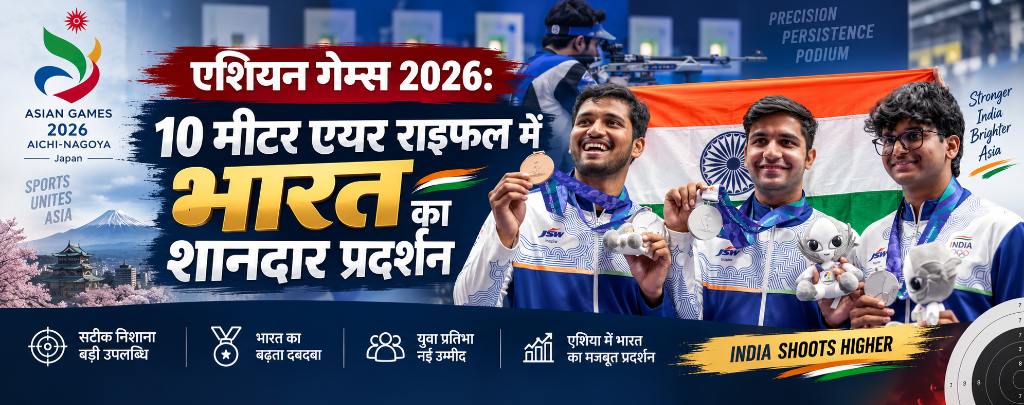
At the 2026 Asian Games in Aichi-Nagoya, Japan, Team India has clinched a total of 19 medals (2 Gold, 8 Silver, 9 Bronze). Indian Women's Cricket Team and Shooters Suruchi & Kamaljeet secured Gold Medals. Explore the complete medal tally, sport-wise breakdown, and full winners list.

Complete 72nd National Film Awards 2026 Winners List in Hindi & English for 2024 certified films. 'Article 370' wins Best Feature Film, Kartik Aaryan & Mammootty win Best Actor, Yami Gautam wins Best Actress. Includes full winners table, Filmfare Awards comparison, and 8 practice MCQs for MPPSC & UPSC.

IPS officer Dr. Sanjukta Parashar (2006 batch, Assam-Meghalaya cadre) has been appointed as the first woman Inspector General (IG) of CRPF CoBRA (Commando Battalion for Resolute Action). Read her career profile, CoBRA operational role, and key exam notes.
Get daily Current Affairs PDFs directly on your WhatsApp, or join our official Telegram & WhatsApp channels.

Comprehensive exam-oriented guide on the 73rd & 74th Constitutional Amendment Acts, 1992. Covers implementation dates (24 April 1993 & 1 June 1993), Parts IX & IXA, 11th & 12th Schedules (29 & 18 subjects), Articles 243A-243ZG breakdown, women reservation (Art 243D), SEC, SFC, DPC, PESA Act 1996, comparative tables, 8 FAQs & 8 MCQs for MPPSC & UPSC.

Enacted on 20 April 1993 and came into force on 24 April 1993 (National Panchayati Raj Day).
| Part Added |
| Part IX |
| Part IXA |
| Schedule | 11th Schedule (29 Subjects) | 12th Schedule (18 Subjects) |
| Enforcement Date | 24 April 1993 | 1 June 1993 |
| Basic Unit | Gram Sabha | Ward Committee |