
1. Overview & Current Cabinet Decision: Renaming to Paschim Banga
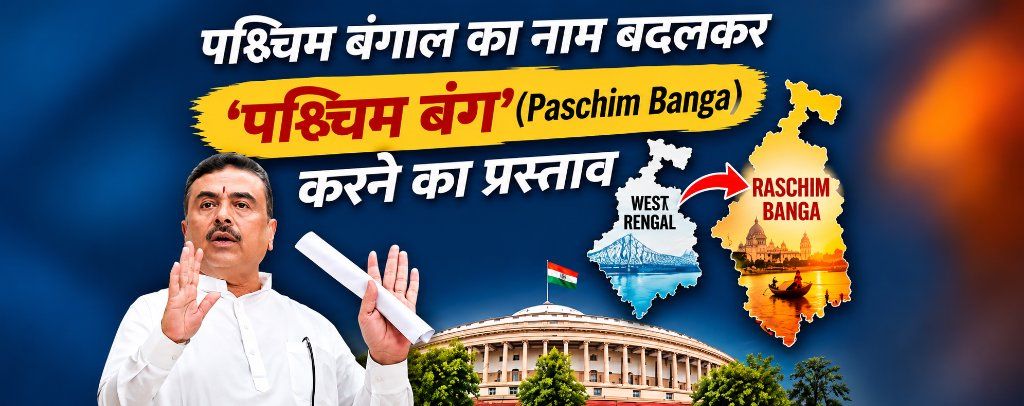
A major administrative and constitutional initiative has emerged regarding the renaming of West Bengal. On November 23, 2026, the State Cabinet headed by Chief Minister Suvendu Adhikari unanimously approved the formal proposal to rename the state as 'Paschim Banga' across all official languages.
Chief Minister Suvendu Adhikari announced that the resolution will be introduced in the West Bengal Legislative Assembly on December 9, 2026, during the ongoing Winter Session (December 4–14, 2026). Once passed by the Assembly, the resolution will be forwarded to the Union Government and the Ministry of Home Affairs. Notably, the proposal specifies adopting 'Paschim Banga' uniformly in English as well, replacing 'West Bengal'.
West Bengal Renaming 2026: Quick Examination Data Table
| Attribute | Official Details |
|---|---|
| Current Official Name | West Bengal (पश्चिम बंगाल) |
| Proposed New Name | Paschim Banga (पश्चिम बंग) — Uniform across all languages |
| State Capital | Kolkata |
| Chief Minister | Suvendu Adhikari |
| Cabinet Approval Date | November 23, 2026 |
| Assembly Tabled Date | December 9, 2026 |
| Assembly Winter Session | December 4 to 14, 2026 |
| Governing Constitutional Articles | Articles 3 and 4 of the Constitution of India |
| Ultimate Legislative Authority | Parliament of India (by Simple Majority) |
| Historical Antecedents | 1905 & 1947 Partitions of Bengal |
- Constitutional Prerogative: State Cabinet approval and legislative resolution represent only the recommendatory stage. Formally altering the name of a State in the First Schedule of the Constitution strictly requires central parliamentary legislation under Article 3. Explore our MPPSC Mains Syllabus and General Awareness Hub.
2. Underlying Rationale: Why Was Renaming West Bengal Necessary?
The demand to rename West Bengal is rooted in three compelling administrative, linguistic, and historical rationales:
(i) Administrative Handicap of Alphabetical Ordering ('W' vs 'P')
- The Alphabetical Bottleneck: Starting with the letter 'W', 'West Bengal' consistently ranks near the absolute bottom of the alphabetical list of Indian States and Union Territories.
- Truncated Speaking Time at National Forums: In critical inter-state conferences such as NITI Aayog Governing Council meetings, Inter-State Council conventions, and GST Council debates, states address the chair in alphabetical order.
- Administrative Parity: By the time the turn for West Bengal arrives, sessions frequently suffer severe time fatigue, forcing state delegates to compress vital fiscal and developmental representations into mere minutes. Transitioning to 'Paschim Banga' vaults the state to letter 'P', securing timely speaking slots.
(ii) Linguistic Identity and Single-Nomenclature Uniformity
- Native Language Concordance: In the state's principal language, Bengali, residents universally refer to their homeland as 'Paschim Banga' (পশ্চিমবঙ্গ) rather than 'West Bengal'.
- Overcoming Multi-Lingual Confusion: Adopting 'Paschim Banga' universally across English, Hindi, and regional records fosters streamlined pan-Indian constitutional uniformity.
(iii) Historical Memory of the 1947 Partition
- Echoes of 1947 Partition: In 1947, Bengal was bifurcated along religious lines; the western Hindu-majority districts formed West Bengal within India, while East Bengal became East Pakistan (liberated as sovereign Bangladesh in 1971).
- Reclaiming Cultural Dignity: While some historical purists debated dispensing with 'West' altogether, 'Paschim Banga' strikes a balanced resonance between historic constitutional continuity and linguistic self-definition.
3. Complete 27-Year History of West Bengal Renaming Attempts (1999–2026)
The institutional quest to rename West Bengal spans 27 years (1999 to 2026), marked by multiple legislative resolutions, central rejections, and diplomatic debates over sovereign naming conflicts.
1999: Left Front Government's Inaugural Resolution
- July 1999 Initiative: The Left Front ministry under Chief Minister Jyoti Basu first piloted a resolution to rename the state 'Paschim Banga'. However, it did not culminate in central parliamentary legislation during the Atal Bihari Vajpayee-led NDA regime.
2011: Mamata Banerjee Cabinet's 'Paschim Banga' Push
- September 2011 Bid: Following the end of 34 years of Left rule, the newly elected Trinamool Congress administration passed an all-party Assembly resolution endorsing 'Paschim Banga', but central sponsorship stalled.
2016: The Tri-Lingual Naming Complexity
- August 2016 Three-Tier Formula: The Assembly proposed three distinct names based on linguistic mediums: 'Bangla' in Bengali, 'Bengal' in English, and 'Bangal' in Hindi.
- MHA Objection: The Ministry of Home Affairs declined the formula, maintaining that the First Schedule of the Constitution mandates a singular, non-divergent nomenclature across all statutory records.
2018–2019: 'Bangla' and the International Diplomatic Impediment
- July 2018 Universal 'Bangla' Resolution: The state assembly unanimously passed a modified resolution adopting 'Bangla' uniformly across English, Hindi, and Bengali.
- July 2019 Central Refusal: The Union Government and Ministry of External Affairs rejected 'Bangla' on foreign policy grounds. The close linguistic similarity between 'Bangla' and sovereign neighbor Bangladesh posed potential diplomatic confusion in international forums like the United Nations.
2026: Consensus Revival of 'Paschim Banga'
- November 2026 Decision: Chief Minister Suvendu Adhikari revived the pragmatic title 'Paschim Banga', avoiding diplomatic overlap while securing the vital alphabetical advantage ('P') in English.
| Year | Government / Chief Minister | Proposed Name | Outcome & Central Stance |
|---|---|---|---|
| 1999 | Left Front (Jyoti Basu) | Paschim Banga | No central statutory enactment |
| 2011 | Trinamool Congress (Mamata Banerjee) | Paschim Banga | Parliamentary bill not introduced |
| 2016 | Trinamool Congress (Mamata Banerjee) | Bangla (Bengali), Bengal (English), Bangal (Hindi) | Rejected by Centre: Multi-lingual divergence |
| 2018 | Trinamool Congress (Mamata Banerjee) | Bangla (Universal) | Rejected by MHA: Diplomatic confusion with Bangladesh |
| 2026 | BJP / NDA (Suvendu Adhikari) | Paschim Banga (Uniform in English) | Cabinet approved; Tabled in Assembly on Dec 9, 2026 |
4. Constitutional Mechanism Under Articles 3 & 4: How a State is Renamed
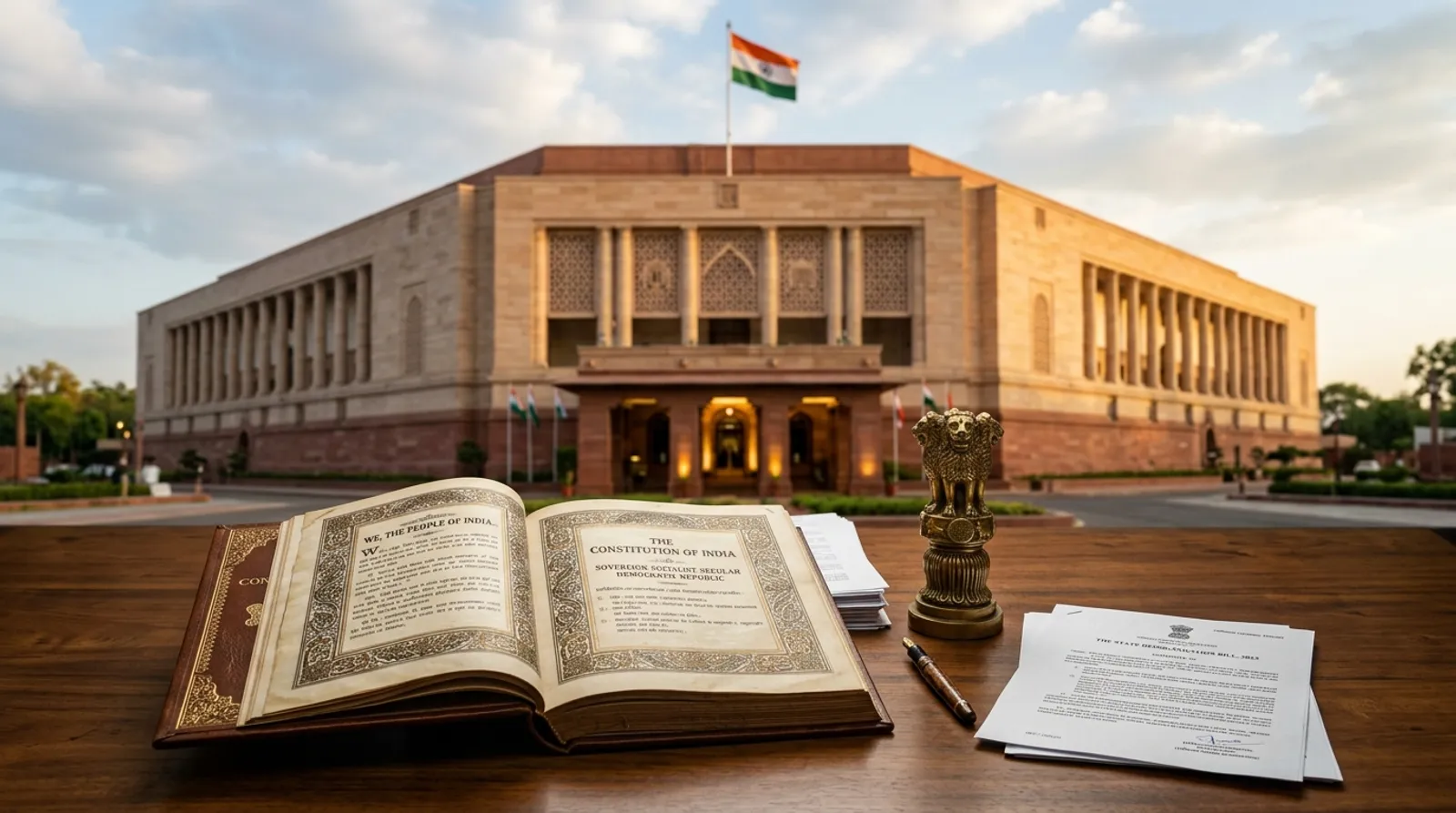
Under the constitutional architecture of India, the Union is an indestructible Union of destructible states. The exclusive authority to alter state boundaries, areas, or names resides solely with the Parliament of India, governed by Articles 3 and 4.
Article 3: Parliamentary Competence Over States
- Substantive Scope of Article 3: Parliament may by law— (a) form a new State; (b) increase the area of any State; (c) diminish the area of any State; (d) alter the boundaries of any State; and (e) alter the name of any State.
Four Mandatory Constitutional Stages in Renaming a State
- Stage 1: Prior Presidential Recommendation: Under the proviso to Article 3, no bill altering the name or boundaries of any state can be introduced in either House of Parliament except on the prior recommendation of the President.
- Stage 2: Reference to State Legislature: Before introducing the bill, the President must refer it to the concerned State Legislature for expressing its views within a specified period.
- Critical Judicial Precedent (Non-Binding Views): The views expressed by the State Legislature are strictly recommendatory and not binding on Parliament or the President (*Babulal Parate v. State of Bombay, AIR 1960 SC 51*). Even if the assembly rejects the proposal, Parliament possesses plenary power to enact it.
- Stage 3: Passage by Simple Majority: The bill requires passage in both the Lok Sabha and Rajya Sabha by a Simple Majority of members present and voting.
- Stage 4: Presidential Assent & Gazette Notification: Following passage, the President accords assent. Upon publication in the Gazette of India by the Ministry of Home Affairs, the renaming takes constitutional effect.
Article 4: Exemption from Article 368 Amendment Rigor
- Exemption from Article 368: Article 4(2) expressly stipulates that laws enacted under Article 2 or Article 3 shall not be deemed to be an amendment of the Constitution for the purposes of Article 368. Consequently, no special majority or ratification by states is required.
- Consequential Alterations: Such legislation automatically updates the First Schedule (List of States and UTs) and Fourth Schedule (Allocation of Rajya Sabha seats) of the Constitution.
5. Historical Matrix of Bengal Partitions: 1905, 1911 and 1947
The contemporary identity of West Bengal and the cardinal designation 'West' can only be understood through three historic partition milestones in modern Indian history:
The 1905 Partition of Bengal: Lord Curzon and Swadeshi Movement
- Curzon's Divide and Rule Strategy: Viceroy Lord Curzon announced the partition on July 20, 1905, taking formal effect on October 16, 1905. Masked under administrative convenience, it strategically severed the nerve center of Indian nationalism along communal lines.
- Genesis of Swadeshi & Boycott: On August 7, 1905, the Swadeshi Movement was formally proclaimed at the Calcutta Town Hall. October 16 was observed as a Day of Mourning and Raksha Bandhan Day, while Rabindranath Tagore penned the historic anthem 'Amar Shonar Bangla'.
1911 Annulment of Partition & Capital Shift to Delhi
- Delhi Durbar 1911: Overwhelmed by revolutionary nationalist pressure, King George V and Viceroy Lord Hardinge II officially annulled the partition of Bengal at the grand Delhi Durbar in December 1911.
- Capital Relocation: Concurrently, the imperial capital of British India was transferred from Calcutta to Delhi, while Bihar and Orissa were partitioned into a separate province.
1947 Partition and Birth of the State of 'West Bengal'
- Mountbatten Plan & Radcliffe Line: During India's independence in August 1947, Sir Cyril Radcliffe's Boundary Commission bifurcated Bengal. The western sector became the Indian State of West Bengal, while the eastern wing formed East Pakistan (which emerged as sovereign Bangladesh after the 1971 Liberation War).
6. Historical Precedents: Other States Renamed in Post-Independence India
Altering the nomenclature of states to honor vernacular heritage and cultural identity is a well-established constitutional practice in independent India:
| No. | Original Name | New Renamed Name | Year | Enacting Parliamentary Legislation |
|---|---|---|---|---|
| 1 | United Provinces (संयुक्त प्रांत) | Uttar Pradesh (उत्तर प्रदेश) | 1950 | United Provinces (Alteration of Name) Order, 1950 |
| 2 | Madras State (मद्रास) | Tamil Nadu (तमिलनाडु) | 1969 | Madras State (Alteration of Name) Act, 1968 |
| 3 | Mysore State (मैसूर) | Karnataka (कर्नाटक) | 1973 | Mysore State (Alteration of Name) Act, 1973 |
| 4 | Laccadive, Minicoy & Amindivi Islands | Lakshadweep (लक्षद्वीप) | 1973 | Laccadive, Minicoy (Alteration of Name) Act, 1973 |
| 5 | Uttaranchal (उत्तरांचल) | Uttarakhand (उत्तराखंड) | 2007 | Uttaranchal (Alteration of Name) Act, 2006 |
| 6 | Orissa (उड़ीसा) | Odisha (ओडिशा) | 2011 | Orissa (Alteration of Name) Act, 2011 |
- The 2011 Odisha Precedent: In 2011, Parliament enacted the 'Orissa (Alteration of Name) Act' alongside the 113th Constitutional Amendment Act to change the language name 'Oriya' to 'Odia' in the Eighth Schedule. A corresponding 'West Bengal (Alteration of Name) Act' will be required for Paschim Banga.
7. High-Yield Exam Memory Points for MPPSC & UPSC Aspirants
- Plenary Power under Article 3: The exclusive legislative competence to alter state names, redraw boundaries, or carve out new territories belongs solely to the Parliament of India.
- Prior Presidential Sanction: Introduction of any bill under Article 3 requires mandatory prior recommendation of the President.
- Non-Binding Nature of State Views: The opinion of the State Legislature on the referred bill is purely advisory and not binding upon Parliament or the President.
- Legislative Threshold: The bill is enacted by a Simple Majority (greater than 50% of members present and voting) in both Houses of Parliament.
- Exemption from Article 368: Pursuant to Article 4(2), laws enacted under Article 3 are not considered constitutional amendments under Article 368.
- Schedules Impacted: The enactment updates the First Schedule (Territories of States) and Fourth Schedule (Allocation of Rajya Sabha seats).
- Key Historical Partition Dates: 1905 Partition enacted by Lord Curzon (Oct 16, 1905); 1911 Annulment by King George V & Lord Hardinge II; 1947 Mountbatten Plan & Radcliffe Commission permanently bifurcated Bengal.
- Landmark Constitutional Ruling: Babulal Parate v. State of Bombay (1960)* — The Supreme Court held that once the original bill has been referred to the state legislature, fresh reference is not required for amendments introduced in Parliament.
Practice Questions
1Under which Article of the Constitution of India does Parliament possess the exclusive power to alter the name of any existing State?
2Prior recommendation of whom is mandatory before introducing a bill altering the name or boundaries of a State in Parliament?
3Which statement is correct regarding the views expressed by the State Legislature under Article 3?
4By what majority must a bill altering the name of a State under Article 3 be passed in each House of Parliament?
5According to Article 4(2), what is the constitutional provision regarding laws made under Article 2 or Article 3?
6Which British Viceroy partitioned Bengal in 1905 and on which date did it come into effect?
7During which historic event in 1911 was the partition of Bengal annulled and the capital shifted from Calcutta to Delhi?
8Which Indian state's name was officially altered in 2011 through parliamentary legislation?