| Parameter | COSMOS-Mysuru (Active LED Dome) | Conventional Planetarium (Projection Based) |
|---|---|---|
1Which premier institution developed India's first LED dome planetarium 'COSMOS-Mysuru'?
2Where was the COSMOS-Mysuru planetarium inaugurated on 13 November 2026?
3What is the physical diameter of the COSMOS-Mysuru tilted LED dome?
4Approximately how many individual micro/mini LEDs power the display surface of COSMOS-Mysuru?
5What display resolution standard is deployed in the COSMOS-Mysuru LED dome planetarium?
6What is the primary scientific advantage of an active LED dome over conventional projector-based planetariums?
7Where is the headquarters of the Indian Institute of Astrophysics (IIA) located?
8On which fundamental physics principle does a Light Emitting Diode (LED) operate?

Why does the Bay of Bengal witness 4 times more cyclones than the Arabian Sea? Detailed analysis of Sea Surface Temperature (>26.5°C), freshwater runoff from Ganga-Brahmaputra, funnel geography, 6-step cyclone genesis, IMD classification, WMO/ESCAP 169-name roster, and 8 practice MCQs for MPPSC & UPSC.

Complete official list of all 48 Indian medal winners (1 to 48) at the 2026 Asian Games in Aichi-Nagoya, Japan. Features Elavenil Valarivan, Rudrankksh Patil, Parth Mane, Himanshu Dhillon, Neeru Dhanda, Mirabai Chanu, Team India Cricket/Kabaddi, and all medalled events with MPPSC notes.

Complete 72nd National Film Awards 2026 Winners List in Hindi & English for 2024 certified films. 'Article 370' wins Best Feature Film, Kartik Aaryan & Mammootty win Best Actor, Yami Gautam wins Best Actress. Includes full winners table, Filmfare Awards comparison, and 8 practice MCQs for MPPSC & UPSC.
Get daily Current Affairs PDFs directly on your WhatsApp, or join our official Telegram & WhatsApp channels.
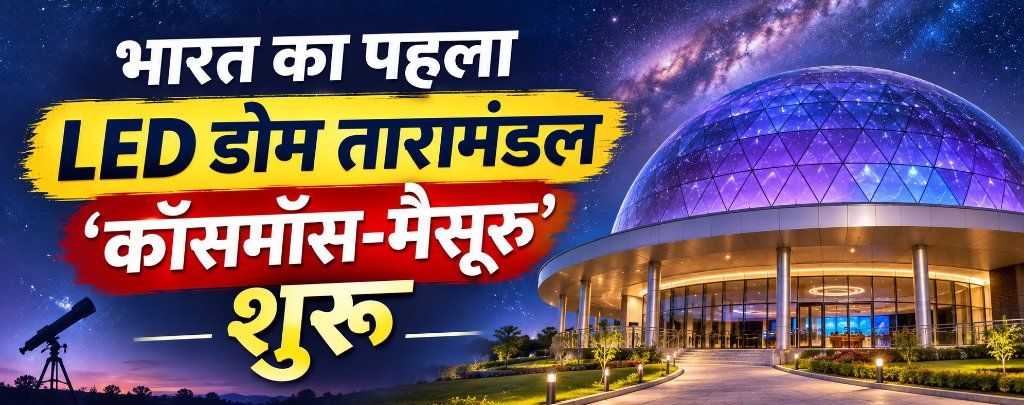
On 13 November 2026, Prime Minister Narendra Modi inaugurated India's first-ever 15-meter tilted LED dome planetarium 'COSMOS-Mysuru' at the University of Mysore campus, Karnataka. Developed by the Indian Institute of Astrophysics (IIA), it features 6,150 LED panels, 4.2 crore individual LEDs, and true 8K resolution. Includes comparative table and 8 practice MCQs for MPPSC & UPSC.

| Display Architecture |
| Self-emissive modular curved surface |
| External optical or digital projectors reflecting onto dome |
| Peak Luminance | Ultra-high luminance (Vibrant even with ambient lighting) | Low to moderate (Requires absolute darkness) |
| Contrast Ratio | Infinite (Pure true blacks when diodes switch off) | Limited (Blacks appear hazy grey due to light scatter) |
| Obstruction & Shadows | Completely shadow-free across entire 360° hemisphere | Susceptible to audience or hardware shadow cast |
| Native Resolution | Native True 8K spatial resolution (42 million diodes) | Typically 2K–4K, subject to edge-blending distortions |
| Operational Lifespan | Exceeds 100,000 operational hours with low degradation | Frequent bulb/laser degradation and optical recalibration |
| Dynamic Research Feeding | Real-time raw astronomical simulations & telescope streams | Primarily restricted to pre-rendered motion files |