
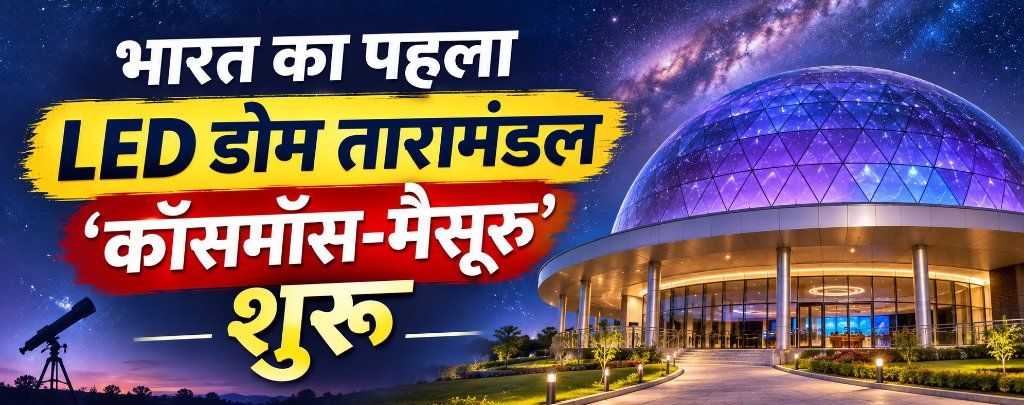

Why in News? (Historic Launch of COSMOS-Mysuru)
India's Landmark Milestone in Astronomy & Optical Tech
- Historic Dedication: On 13 November 2026, Prime Minister Narendra Modi inaugurated India's first-ever state-of-the-art LED Dome Planetarium named 'COSMOS-Mysuru' at the Manasagangotri campus of the University of Mysore, Karnataka.
- Developing Institution: Conceived and executed by the premier autonomous institute under the Department of Science and Technology (DST) — the Indian Institute of Astrophysics (IIA, Bengaluru) — in institutional collaboration with the University of Mysore.
- Exam Alignment: Directly relevant for MPPSC Prelims Paper 1 Unit 7 (Indian Scientific Institutions & Achievements) and MPPSC Mains Paper 3 Unit 7 (Science & Technology Innovations).
COSMOS-Mysuru: Core Technical Specifications & Architecture
Core Pillars of Technical Excellence
- 15-Meter Tilted Hemispherical Dome: Engineered with a 15-meter diameter dome inclined at a 15-degree angle, optimizing human ergonomic line-of-sight for immersive horizon-to-zenith viewing without neck strain.
- 6,150 Modular LED Panels: Precision-tiled with 6,150 custom curved active-matrix LED modules forming a continuous, perfectly seamless curvilinear canvas.
- 4.2 Crore (42 Million) Discrete LEDs: Powered by an astonishing matrix of approximately 42 million individually controllable RGB micro/mini light-emitting diodes.
- True 8K Spatial Resolution: Capable of ultra-high dynamic range 8K spatial rendering (7680 × 4320 effective baseline) driven at high temporal refresh rates (60/120 Hz).
- Self-Emissive Active Display: Eliminates traditional optical and digital projectors entirely. Every pixel generates its own light, eliminating throw shadows, beam scattering, and bulb degradation.
Comparative Analysis: LED Dome vs Traditional Optical Projector Planetarium
- Technological Paradigm Shift: Benchmarking next-generation active-matrix LED domes against conventional optical-mechanical and digital projection systems:
Comparative Analysis: LED Dome vs Conventional Projection Planetarium
| Parameter | COSMOS-Mysuru (Active LED Dome) | Conventional Planetarium (Projection Based) |
|---|---|---|
| Display Architecture | Self-emissive modular curved surface | External optical or digital projectors reflecting onto dome |
| Peak Luminance | Ultra-high luminance (Vibrant even with ambient lighting) | Low to moderate (Requires absolute darkness) |
| Contrast Ratio | Infinite (Pure true blacks when diodes switch off) | Limited (Blacks appear hazy grey due to light scatter) |
| Obstruction & Shadows | Completely shadow-free across entire 360° hemisphere | Susceptible to audience or hardware shadow cast |
| Native Resolution | Native True 8K spatial resolution (42 million diodes) | Typically 2K–4K, subject to edge-blending distortions |
| Operational Lifespan | Exceeds 100,000 operational hours with low degradation | Frequent bulb/laser degradation and optical recalibration |
| Dynamic Research Feeding | Real-time raw astronomical simulations & telescope streams | Primarily restricted to pre-rendered motion files |
Engineering Architecture & Scientific Operating Principles
1. Semiconductor P-N Junction & Electroluminescence
- Physics Foundation: A Light Emitting Diode (LED) operates on the principle of solid-state electroluminescence. When a forward bias current flows through the semiconductor p-n junction, electrons recombine with electron holes, releasing energy as photons.
2. Active-Matrix Addressing & Sub-Millimeter Pitch
- Micro-Precision Control: Each of the 42 million diodes is independently modulated via high-speed micro-controllers. Ultra-fine pixel pitch prevents optical screen-door artifacts, creating an indistinguishable synthetic celestial firmament.
3. Absolute True Black & Infinite Dynamic Contrast
- Cosmic Realism: Cosmic space is overwhelmingly pitch-black. Traditional projectors bleed stray light, rendering voids as washed-out grey. With active LED technology, diodes are turned off entirely (zero luminance output), reproducing true deep cosmic voids.
Strategic Scientific, Academic & Research Applications
1. Advanced Computational Astrophysical Modeling
- Complex Dynamic Simulations: Allows spatial visualization of complex relativistic astrophysics: binary neutron star mergers, black hole accretion physics, gravitational lens warping, and cosmic web filament evolution.
2. Direct Telemetric Ingestion from Indian Observatories
- National Observational Grid: Directly interfaced to ingest astronomical observations from the Himalayan Chandra Telescope (Hanle, Ladakh), Vainu Bappu Observatory (Kavalur), Udaipur Solar Observatory, and ISRO's Aditya-L1 solar coronagraph data.
3. STEM Education & Scientific Temper Promotion
- Inspiring Next-Gen Scientists: Fosters curiosity in young students across physics, astronomical instrumentation, computational science, and aerospace engineering.
4. Flagship Destination for Science Tourism
- Global Scientific Hub: Augments Mysuru's heritage circuit (Mysuru Palace, Chamundi Hills) with world-class scientific infrastructure attracting international scholars and tourists.
Essential Acronyms & Institutional Background for MPPSC & UPSC
- IIA (Indian Institute of Astrophysics): Premier autonomous national research institution under the Department of Science and Technology (DST), Govt of India. Headquarters: Bengaluru, Karnataka. Operates world-class facilities including Hanle Gamma-Ray & Optical Telescopes in Ladakh.
- LED (Light Emitting Diode): Solid-state semiconductor optoelectronic diode emitting photon streams directly under electrical forward bias.
- 8K UHD: Display resolution standard delivering 7680 × 4320 pixels (33.18 million pixels per frame) — 4 times the detail of 4K and 16 times of standard 1080p.
- COSMOS: Cosmological scientific outreach and astrophysics research visualization initiative.
- DST: Department of Science & Technology, Ministry of Science & Technology, Government of India.
High-Yield Quick Revision Highlights for MPPSC & UPSC
- First LED Dome Planetarium of India: COSMOS-Mysuru.
- Geographic Location: University of Mysore (Manasagangotri), Karnataka.
- Inauguration Date: 13 November 2026.
- Dignitary: Prime Minister Narendra Modi.
- Lead Institution: Indian Institute of Astrophysics (IIA, Bengaluru).
- Physical Geometry: 15-meter diameter, 15-degree tilted hemispherical dome.
- Modular LED Count: Approximately 6,150 active modules.
- Total Diode Population: ~4.2 crore (42 Million) individual micro/mini LEDs.
- Display Resolution: True 8K Ultra-High Definition.
- Projector Dependency: Zero (Self-emissive direct LED architecture).
Practice Questions
1Which premier institution developed India's first LED dome planetarium 'COSMOS-Mysuru'?
2Where was the COSMOS-Mysuru planetarium inaugurated on 13 November 2026?
3What is the physical diameter of the COSMOS-Mysuru tilted LED dome?
4Approximately how many individual micro/mini LEDs power the display surface of COSMOS-Mysuru?
5What display resolution standard is deployed in the COSMOS-Mysuru LED dome planetarium?
6What is the primary scientific advantage of an active LED dome over conventional projector-based planetariums?
7Where is the headquarters of the Indian Institute of Astrophysics (IIA) located?
8On which fundamental physics principle does a Light Emitting Diode (LED) operate?