

Executive Summary & Direct Answer
⚡
Direct Answer: The Portuguese arrived first in India (1498) and left last (1961). The correct arrival sequence is: Portuguese (1498) -> Dutch (1605) -> English (1608) -> Danish (1620) -> French (1668). However, due to naval dominance, financial autonomy, and victory in the Battle of Wandiwash (1760), the British established supreme colonial rule.
Quick Facts
- Subject: Arrival of European Companies in Medieval & Modern India
- Major European Powers: Portuguese, Dutch, British, Danish, French
- Primary Objectives: Trade Monopoly, Sea Route Discovery, Colonization, Political Control
- Exam Relevance: UPSC, MPPSC, State PCS & Other Competitive Exams
Comparative Matrix of European Companies
⚠️
Exam Alert: Key distinction between Company Establishment Year and Arrival Year in India:
Comparative Matrix of European Companies in India
| Company | Established | Arrival | First Factory | Headquarters | Final Outcome / Battle |
|---|---|---|---|---|---|
| Portuguese | 1498 AD | 1498 AD | Cochin (1503) | Goa | Defeated by Dutch & British |
| Dutch (VOC) | 1602 AD | 1605 AD | Masulipatnam (1605) | Pulicat / Nagapattinam | Battle of Bedara (1759) |
| British (EIC) | 1600 AD | 1608 AD | Surat (1613) | Calcutta (Fort William) | Supreme until 1858 |
| Danish | 1616 AD | 1620 AD | Tranquebar (1620) | Serampore (Bengal) | Sold settlements (1845) |
| French | 1664 AD | 1668 AD | Surat (1668) | Pondicherry | Battle of Wandiwash (1760) |
Primary Reasons for European Arrival in India
- Control over Spice Trade: Securing monopoly over high-value Indian spices.
- Breaking Arab Monopoly: Bypassing Arab and Venetian merchants on overland trade routes.
- Direct Sea Routes: Discovering direct oceanic routes to India and the East Indies.
- Commercial Profits: Maximizing revenue through new consumer markets.
- Colonial Expansion: Establishing fortified commercial posts and colonies.
- Religious Proselytization: Spreading Christianity across Asia.
1. The Portuguese in India
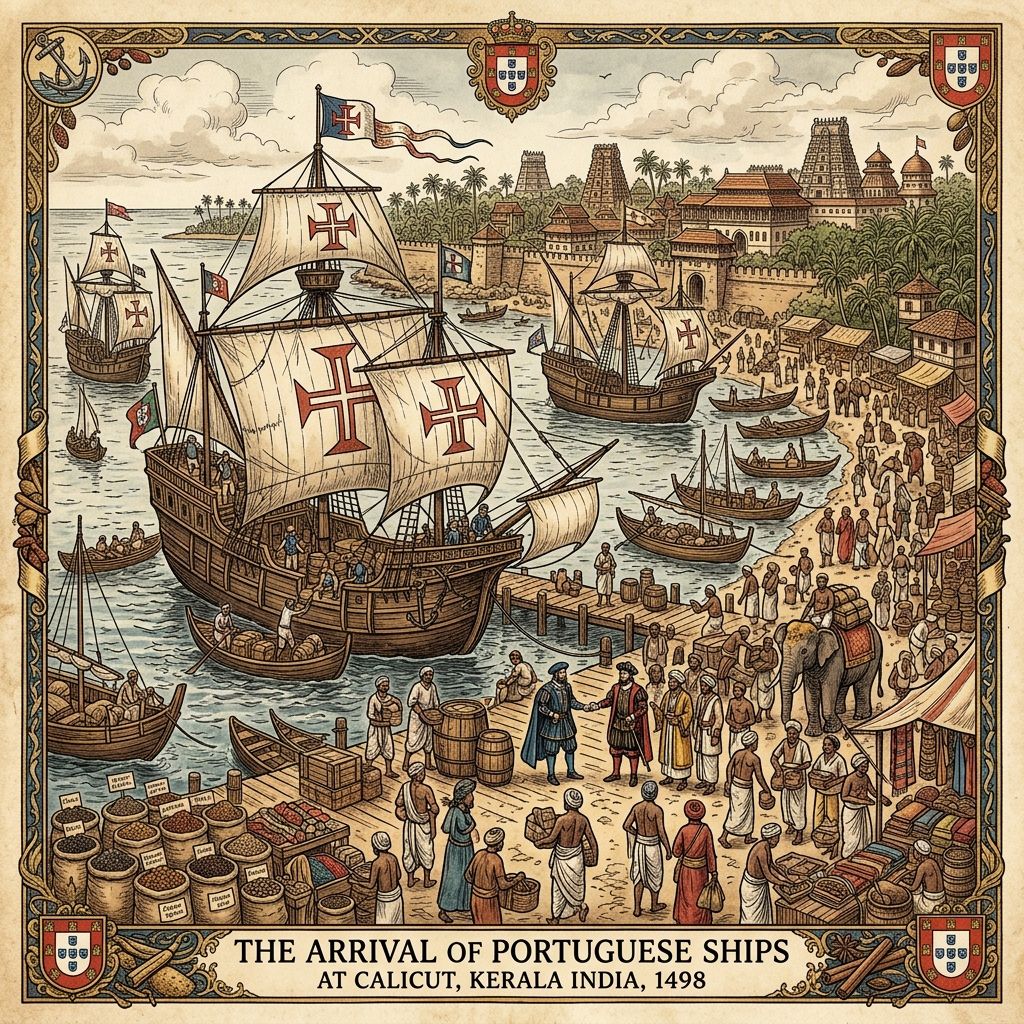
- 1498 AD: Vasco da Gama reached Calicut (Kerala).
- First European: Vasco da Gama was the first European explorer to reach India by sea.
- Route: Traveled via the Cape of Good Hope route around Africa.
- Welcome: Welcomed by Zamorin, the ruler of Calicut.
- Francisco de Almeida (1505): First Portuguese Governor (Initiator of 'Blue Water Policy').
- Afonso de Albuquerque (1509): Real founder of Portuguese power in India.
- 1510 AD: Captured Goa from Bijapur Sultanate.
- Capital: Goa became the official capital of Portuguese India.
- Major Trade Centers: Goa, Cochin, Daman, Diu, and Calicut.
2. The Dutch East India Company (VOC)
- 1602 AD: Establishment of Dutch East India Company.
- Original Company Name: VOC (Vereenigde Oostindische Compagnie).
- First Factory: Established in Masulipatnam in 1605 AD.
- Headquarters: Pulicat (later shifted to Nagapattinam).
- Major Trade Commodities: Spices, cotton textiles, indigo, and saltpetre.
- Major Centers: Pulicat, Nagapattinam, Masulipatnam, Cochin, Chinsurah.
- Fall (1759 AD): British decisively defeated Dutch in the Battle of Bedara.
3. The British East India Company (EIC)
- Dec 31, 1600: Royal Charter granted by Queen Elizabeth I establishing EIC.
- 1608 AD: Captain Hawkins arrived at Emperor Jahangir's court.
- 1615 AD: Sir Thomas Roe secured royal trade concessions from Jahangir.
- 1613 AD: First permanent factory established at Surat.
- Major Presidencies: Surat, Madras (Fort St. George), Bombay, Calcutta (Fort William).
- 1757 AD: Battle of Plassey - Beginning of political control over Bengal.
- 1764 AD: Battle of Buxar - Firm foundation of British supremacy in India.
- 1765 AD: Treaty of Allahabad granted Diwani rights over Bengal, Bihar, and Orissa.
- 1858 AD: Company rule abolished; British Crown assumed direct governance.
4. The Danish East India Company
- 1616 AD: Establishment of Danish East India Company.
- Major Settlements: Tranquebar (Tamil Nadu - 1620) and Serampore (Bengal - 1676).
- Core Focus: Focused more on Christian missionary work than commercial empire.
- Final Position: Sold all Indian settlements to the British by 1845.
5. The French East India Company
- 1664 AD: Established by Jean-Baptiste Colbert under King Louis XIV.
- First Factory: Established at Surat in 1668 AD by Francois Caron.
- Headquarters: Pondicherry (founded in 1673 by Francois Martin).
- Key Centers: Pondicherry, Chandernagore, Mahe, Karaikal, Yanam.
- Famous Governor: Joseph Francois Dupleix - Pioneer of political intervention policy.
- Decline: Defeated in Carnatic Wars (1746–1763), ending French political ambitions.
Anglo-French Struggle: Carnatic Wars (1746–1763)
- First Carnatic War (1746–1748): Fallout of War of Austrian Succession. French captured Madras. Ended with Treaty of Aix-la-Chapelle (1748).
- Second Carnatic War (1749–1754): Sparked by succession disputes in Hyderabad & Carnatic. Dupleix recalled. Ended with Treaty of Pondicherry (1754).
- Third Carnatic War (1756–1763): Part of Global Seven Years' War. Decisive Battle of Wandiwash (1760) where British under Eyre Coote defeated French.
- Treaty of Paris (1763): French restricted to trade only; lost right to fortify settlements.
Key Factors Behind British Victory
- Naval Superiority: British possessed the world's most formidable navy.
- Commercial Autonomy: Private corporate structure of EIC enabled agile decision making compared to state-run French company.
- Bengal Conquest: Conquest of rich Bengal provided limitless financial capital.
- Military Leadership: Exceptional leadership of Clive, Eyre Coote, and Hector Munro.
- Indian Disunity: Exploit native rulers' internal rivalries and lack of unified resistance.
Socio-Economic Impact of European Arrival on India
- Positive: Expansion of maritime trade and global markets; rise of major port cities (Bombay, Madras, Calcutta); introduction of printing press.
- Negative: Destruction of traditional Indian handicrafts (Deindustrialization); unilateral drain of wealth; loss of political sovereignty and colonial subjugation.
Timeline of Major Historical Events
- 1498: Vasco da Gama arrived at Calicut
- 1505: Francisco de Almeida appointed 1st Portuguese Governor
- 1510: Albuquerque captured Goa
- 1600: British East India Company incorporated (Dec 31)
- 1602: Dutch East India Company (VOC) established
- 1613: British 1st permanent factory established at Surat
- 1616: Danish East India Company founded
- 1664: French East India Company founded
- 1746–1763: Carnatic Wars (Anglo-French conflicts)
- 1757: Battle of Plassey
- 1759: Battle of Bedara (Dutch power eliminated)
- 1760: Battle of Wandiwash (French decisively defeated)
- 1763: Treaty of Paris
- 1764: Battle of Buxar
- 1765: Treaty of Allahabad (Diwani Rights obtained)
- 1858: EIC Rule ended; Crown Rule established
Practice Questions
1Vasco da Gama reached which coast of India in 1498 AD and was welcomed by which ruler?
2Which Portuguese Governor captured Goa from Bijapur in 1510 AD to solidify Portuguese control?
3What was the historical outcome of the Battle of Bedara (1759 AD) in India?
4Where did the British East India Company set up its first permanent trading factory in 1613 AD?
5Which treaty brought an end to the First Carnatic War (1746–1748)?
6Which statement is correct regarding the Battle of Wandiwash fought in 1760 AD?
7Which European company sold all its Indian settlements to the British due to limited commercial resources?
8What is the correct chronological sequence of the arrival of European powers in India?
Frequently Asked Questions
Article Sources
3 sources
Article Sources
3 sources