
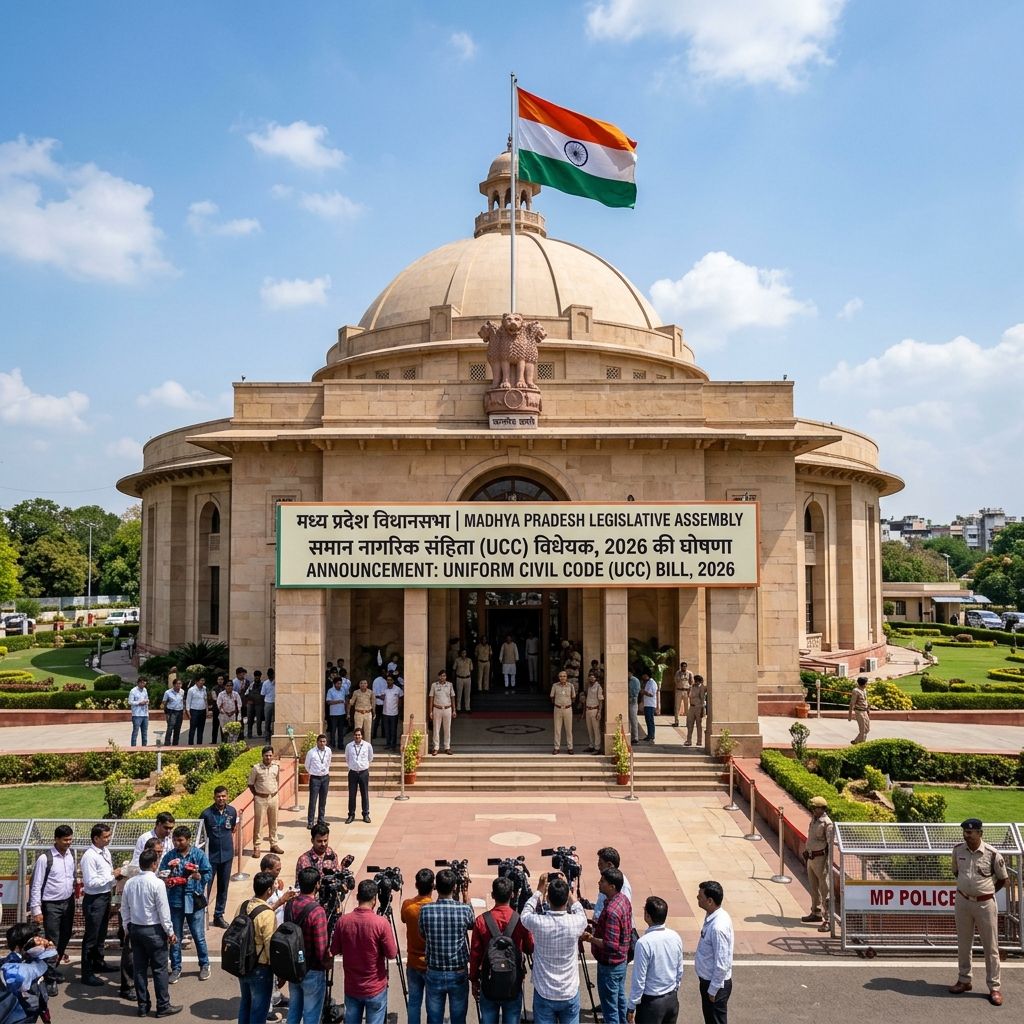

Context & Why in News?
The Madhya Pradesh Legislative Assembly has passed the Uniform Civil Code (UCC) Bill, 2026. With this, Madhya Pradesh has become the fourth state in India to pass a UCC bill, following Uttarakhand, Gujarat, and Assam. This legislation is considered a historic step toward establishing a uniform civil law framework governing marriage, divorce, inheritance, maintenance, guardianship, and property rights. Its core objectives include empowering women and children, promoting social equality, and implementing the mandate of Article 44 of the Indian Constitution.
Key Highlights
- Madhya Pradesh Assembly: Passed the UCC Bill 2026.
- Fourth State: Became the 4th state to pass the UCC Bill after Uttarakhand, Gujarat, and Assam.
- Triple Talaq & Nikah Halala: Criminalized practices like Triple Talaq and Nikah Halala.
- Mandatory Registration: Compulsory registration of all marriages and divorces.
- Rights of Women & Children: Special emphasis on gender equality and equal inheritance rights for all children.
| Parameter | Details |
|---|---|
| Bill Name | Uniform Civil Code (UCC) Bill, 2026 |
| State | Madhya Pradesh |
| National Status | 4th State to pass UCC Bill |
| Primary Objective | Uniform civil laws & empowerment of women and children |
| Constitutional Basis | Article 44 (DPSP) |
What is Uniform Civil Code (UCC) & Constitutional Basis?
What is Uniform Civil Code (UCC)?
- Definition: A Uniform Civil Code (UCC) refers to a single set of secular laws governing personal matters such as marriage, divorce, inheritance, adoption, maintenance, and property for all citizens of India, replacing religion-based personal laws.
Constitutional Basis
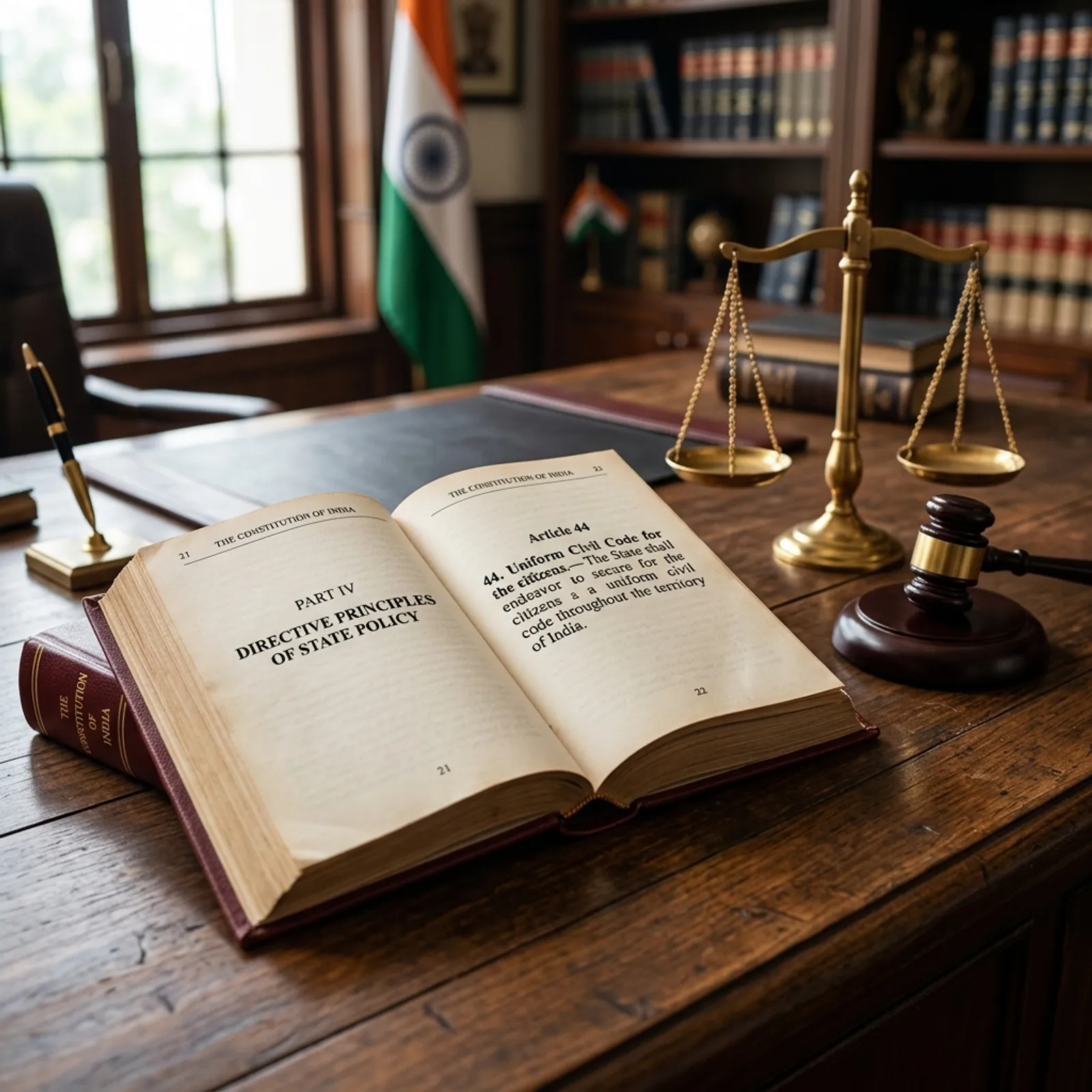
Article 44
- Under the Directive Principles of State Policy (DPSP) in Part IV of the Constitution, the State shall endeavor to secure for citizens a Uniform Civil Code throughout the territory of India.
Related Articles
- Article 14: Equality before law and equal protection of laws.
- Article 15: Prohibition of discrimination on grounds of religion, race, caste, sex, or place of birth.
- Article 25: Freedom of conscience and free profession, practice, and propagation of religion.
Key Features of Madhya Pradesh UCC Bill 2026
1. Monogamy Mandate
- Polygamy: Polygamy is completely abolished.
- Valid Marriage: Only one living spouse permitted at any time.
2. Prohibition of Triple Talaq
- Triple Talaq: Instant Triple Talaq (Talaq-e-Biddat) declared illegal and criminalized.
3. Ban on Nikah Halala
- Nikah Halala: Practicing Nikah Halala and forced marriages made punishable offenses.
4. Mandatory Marriage Registration
- Registration: Compulsory registration of all marriages within prescribed timelines.
- Infrastructure: Registration centers designated from Gram Panchayats to Municipal Corporations.
5. Mandatory Divorce Registration
- Divorce: Every divorce granted by court decree must be officially registered.
6. Enhanced Rights for Women
- Property: Equal rights in ancestral and acquired family property.
- Maintenance: Mandatory maintenance rights during separation or divorce.
7. Equal Status for All Children
- Biological: Equal rights for biological children.
- Adopted: Full legal equality for adopted children.
- ART & Surrogacy: Children born through Assisted Reproductive Technology (ART) and Surrogacy given complete legal status.
8. Equal Inheritance Rights
- Son & Daughter: Sons and daughters receive identical shares in inheritance.
- Marital Status: No distinction between married and unmarried daughters.
9. Child Custody Principle
- Best Interest of Child: Child custody determined solely on the 'Best Interest of the Child'.
10. Live-in Relationship Regulations
- Registration: Mandatory registration of live-in relationships within 1 month of cohabitation.
- Penalties: Failure to register within 30 days attracts fines and imprisonment.
- False Details: Providing false information during registration is a punishable offense.
11. Rights of Children Born in Live-in Relationships
- Legitimacy: Children born out of registered live-in relationships hold full legal legitimacy.
- Inheritance: Entitled to inherit property from both parents.
12. Disqualification for Homicide
- Inheritance Bar: Anyone committing or abetting murder to claim inheritance is permanently barred.
13. Exemption for Scheduled Tribes
- Scheduled Tribes (ST): ST communities protected under Constitution excluded from UCC scope.
- Customary Protections: Preserved customary laws of indigenous tribal groups.
Special Rights for Women
- Protection against Desertion: Legal protection if a spouse lives with another partner.
- Maintenance Security: Guaranteed maintenance and housing rights.
- Equal Property Rights: Complete equality in property and assets.
Penal Provisions
- Non-registration of Live-in: Penalty for non-registration within 1 month.
- False Information: Criminal liability for submitting misleading documents.
- Legal Violations: Penalties including fines, imprisonment, or both for law breaches.
UCC State-wise Status, Historical Evolution & MP Committee
State-wise Status of UCC in India
The implementation and legislative status of UCC across Indian states is detailed below:
| State | Implementation & Legislative Details |
|---|---|
| Uttarakhand | Fully implemented on January 27, 2025 (First state in post-independence India) |
| Gujarat | UCC Bill passed by Legislative Assembly in March 2026 |
| Assam | UCC Bill passed by Legislative Assembly in May 2026 |
| Madhya Pradesh | UCC Bill 2026 passed by Legislative Assembly (4th State in India) |
| Goa | Governed by Portuguese Civil Code, 1867 since pre-independence |
Why is Goa Significant?
- Portuguese Civil Code, 1867: Goa has operated under the Portuguese Civil Code since 1867.
- Post-Independence: After Goa's liberation in 1961, the existing uniform civil law was retained.
- Significance: Goa remains the only state with a long-standing historical uniform civil code.
Historical Evolution of UCC
- 1835: Lex Loci Report under British rule advocated uniform laws for crimes and evidence, excluding personal laws.
- 1840: Codification of crime and contract laws across British India.
- 1941: B. N. Rau Committee constituted to codify Hindu law.
- 1948: Draft Hindu Code Bill introduced in the Constituent Assembly.
- 1950: Enshrined under Article 44 (DPSP) of the Indian Constitution.
Madhya Pradesh UCC Expert Committee
- Date of Formation: April 27, 2026
- Chairperson: Justice (Retd.) Ranjana Prakash Desai
- Committee Size: 7-member expert panel
Arguments in Favor of UCC & Key Controversies
Arguments in Favor of UCC
- Uniformity for All Citizens: Replaces religious personal laws with a single secular law for all citizens.
- Women Empowerment: Ends discriminatory practices like Triple Talaq and Nikah Halala; ensures property inheritance equality.
- Gender Equality: Guarantees identical legal status and security for men and women.
- Social Justice: Protects vulnerable sections, children, and spouses during legal separations.
- Legal Simplification: Simplifies complex personal law jurisprudence into a streamlined framework.
- National Integration: Strengthens secularism and national solidarity.
Major Controversies & Challenges
- Religious Freedom vs. Uniform Law: Harmonizing Article 25 (Freedom of Religion) with Article 44 (UCC).
- Personal Law Concerns: Apprehensions regarding state interference in minority personal laws.
- Cultural Diversity: Preserving India's diverse customs and traditions.
- Federal Dynamics: Subject falls under the Concurrent List, leading to state-wise legislative variations.
Exam Point of View & Quick Revision
Exam Essentials (Key Takeaways)
- UCC → Uniform Civil Code
- Article 44 → Uniform Civil Code under Part IV (DPSP) of the Indian Constitution.
- Part IV → Directive Principles of State Policy (DPSP).
- First State to Implement UCC → Uttarakhand (January 27, 2025).
- 4th State to Pass UCC Bill → Madhya Pradesh (2026).
- Goa → Portuguese Civil Code, 1867 (Historically uniform personal law state).
- ST Exemption → Scheduled Tribes excluded from UCC scope.
- Registration → Mandatory for all marriages, divorces, and live-in relationships (within 30 days).
Full Forms
- UCC: Uniform Civil Code
- DPSP: Directive Principles of State Policy
- ART: Assisted Reproductive Technology
Prelims Quick Revision
- Article 44 → UCC Provision
- Part IV → DPSP Framework
- First State → Uttarakhand
- 4th State → Madhya Pradesh
- Goa → Portuguese Civil Code 1867
- Triple Talaq → Criminalized
- Nikah Halala → Banned
- ST Exemption → Full exclusion for Scheduled Tribes
Mains Value Addition
- Core Philosophy: The enactment of UCC fulfills the Directive Principle of Article 44 by securing gender justice, legal equity, and protection for women and children across all personal law matters.
Practice Questions
1Which state has become the 4th state in India to pass the Uniform Civil Code (UCC) Bill, 2026?
2Under which Article of the Indian Constitution is the provision for Uniform Civil Code (UCC) included in DPSP?
3Which is the first state in post-independence India where the Uniform Civil Code (UCC) was fully implemented?
4Who chaired the Madhya Pradesh Uniform Civil Code (UCC) Expert Committee?
5Under the MP UCC Bill 2026, what is the mandatory timeframe for registering a live-in relationship?
6Which of the following communities is explicitly exempted from the scope of the MP UCC Bill 2026?
7Which Indian state has historically operated under uniform civil laws under the Portuguese Civil Code, 1867?
8Which committee was formed in colonial India in 1941 to codify Hindu law, laying the groundwork for the Hindu Code Bill?
Frequently Asked Questions
Article Sources
3 sources
Article Sources
3 sources